Author Archives: Paul Draper

The Fairlight Connection to our Royal Family

From the 8th Earl Waldegrave back to King James II and then back to William the Conqueror

By Paul Draper

Did you know that the great x3 grandson of King James II of England is buried at St. Andrew’s, Fairlight?

When we look at the burial register covering 1813-1881, we find William, the 8th Earl Waldegrave, R.N., C.B. buried at St. Andrew’s 2nd November 1859:-

                                                    William, the 8th Earl Waldegrave

The Earls of Waldegrave, a current line of the peerage of the United Kingdom, are a well documented family with clear lineage and the Waldegraves themselves are worthy of a full study :

Williams’s great grandfather was James, the 1st Earl Waldegrave. (William’s father was the 4th Earl and his father the 3rd Earl, such was the law of succession of hereditary titles!).

James Waldegrave, was born was in 1684, the son of Henry, the 1st Baron Waldegrave and his wife Henrietta FitzJames. The new honorary title of Earl Waldegrave was thus created.

Henrietta is the important link in this story – She was born in 1667, one of four recognised illegitimate children of King James II of England and his mistress, Arabella Churchill.

King James II actually had two wives, Anne Hyde and Mary of Modena and they produced multiple children by James II, the majority of whom died in childbirth or infancy. The Royal line continued with Mary II, Queen of England, Scotland and Ireland and then later, Anne, Queen of Great Britain. (This was the period of William of Orange and the Battle of the Boyne)

However, our interest is from the illegitimate line. Arabella herself was part of the family line of Sir Winston Churchill, but she did not marry James – indeed her father was also actually named Sir Winston Churchill.

Returning to our celebrity grave, William the 8th Earl Waldegrave was widowed when his first wife, Elizabeth (nee Whitbread) and the mother of his eight children, died on 1st March 1843.

He then re-married a widow, Mrs. Sarah Milward (nee Whitear), on 8th December 1846 at Marylebone, London.

This is the Sarah Milward who in April 1845 had laid the foundation stone for the new St. Andrew’s church. Indeed to demonstrate the importance of this timing for St. Andrew’s, a statement was produced in 1848 to list how the funds were raised to rebuild the church and it lists ‘The Countess Waldegrave’ as the main contributor, donating £1,000 (although she was still the wealthy widow, Mrs Sarah Milward in 1845).

Sarah, who had inherited the Milward Estate from her first husband, Edward Milward, made many donations to local churches in the Hastings area, including, Halton, St. Mary Magdalen, Holy Trinity, Christ Church Ore, St. Matthew Silverhill, St. John Hollington, St. Helen Ore and others. Truly a very generous lady dedicated to the churches of Hastings and the neighbouring areas.

Sarah outlived the 8th Earl by thirteen years and died in 1873. She was buried on 25th April 1873 with the 8th Earl at Fairlight.

See her burial entry from the registers below:-

Below is a photograph of their grave taken in 2016 clearance of their grave:-


The engraving is in two separate bands that circumnavigate the grave.

The inscription is as follows:

Upper band: “Here rest in the hope of a / joyful resurrection the bodies of William 8th Earl Waldegrave, C.B., Vice Admiral / Lord of Radstock / Hall Essex 27th October 1788 Died at Hastings 24th October 1859”

Lower band: “ Also of Sarah his 2nd wife / first of Edward Milward Esq. of Hastings and Daughter of the Revd Prebendary Whitear / born of Hastings 17th / January 1787 Died 18th April 1873. Jesus said I am the resurrection and the life John XI 25”

The Royal story does not end with James II. In fact, if we trace back his bloodline, one generation at a time, for another seventeen generations it leads to William I, better known as William the Conqueror!

We will not list all of the seventeen steps in this article, but can tell you a few:

James II’s father was King Charles I – we all know what happened to him.

James II’s grandfather was King James I of England and VI of Scotland.

James II’s great grandmother was Mary, Queen of Scots – again we know what happened to her.

Going further back in his bloodline we find another eight Kings of England – King Edward the IV, the III, the II and the I, together with King Henry the VII, the II and the I and the one and only King John. There are several generations where the male was not a King, but the lineage returns to the monarchy.

The list reads like a who’s who of our monarchy with a few notable exceptions. In fact, the current Queen of England, Elizabeth II, is also a descendant of King James I. As a result, the current Earl Waldegrave, James, the 13th Earl is the 10th cousin, once removed of our Queen.

Therefore, in the current year of 2016 when we are celebrating the 950th anniversary of the Battle of Hastings, we can claim that we, in Fairlight, have the grave of a direct descendant of William the Conqueror.

A pamphlet detailing the more notable graves at St. Andrew’s is available on request or from inside the church.

(If anyone has any further information or wants to discuss matters in greater detail, please contact me on telephone number 01424 814154. Email available on request)

By Paul Draper (April 2016)
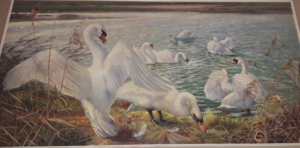
Arthur Spencer Roberts and the Swans in the Village Hall

By Julie Marshall

Arthur Spencer Roberts and the swans in the Village Hall

Arthur Spencer Roberts’ Swans

Have you ever noticed the painting of the swans which hangs in the smaller of the two main rooms in the Village Hall?  Even if you have noticed it, do you know who it is by and how it comes to belong to the Village Hall?  We have unravelled part of the story but if any reader knows more, please contact us and share your knowledge

Continue reading

The Sad Case of Miss Elizabeth Lavender

By Steve Green

Over 200 years ago on the 20th January 1799, the body of a new born baby boy was found in a wooden barrel. Suspicion immediately fell on a young woman named Elizabeth Lavender. Apparently, the day before a doctor had attended during her labour and the body discovered the following day. The Coroner was summoned and at the inquest determined that the baby had suffered a stab wound it his throat five inches long and three inches deep.

In due course the Coroner’s Jury returned a verdict of wilful murder of her male ‘bastard’ child. Elizabeth was arrested placed in goal and sent to the next Sussex Assizes for trial (she had to wait until July 19th  because a key witness, Elizabeth Hedgecock, was heavily pregnant and could not travel) where Elizabeth twice pleaded not guilty. Nevertheless, the court found against her and she was sentenced to be hung for infanticide (‘murder of a bastard child’ as it was known in the day) three days later on Horsham Common; this was summery justice 18th style.  Anyway, if that was not bad enough, her body was then to be given over for medical research to be dissected and anatomised as required under the ‘1752 Murder Act’. At the time there were four others who on the day were found guilty of capital offences and they were subsequently pardoned (although they don’t appear to have committed murder) so unsurprisingly (after all it was 1799!) no such reprieve for poor Elizabeth Lavender, quite rightly you might say given the ghastly crime.

Therefore on the morning of 22nd July 1899 she was duly taken in an open cart to her place of execution to be greeted by crowds of onlookers. This was entertainment of the worst kind. Apparently, the Horsham hangings became known as the ‘Horsham Fairs’. I suppose this was an 18th century version of going to the pictures.  In tears, Elizabeth was led up the scaffold to be greeted by a priest who gave her what words of comfort as he would allow himself. She listened attentively and expressed ‘a hope that all other females would take warning by her untimely fate’ she was turned off about half past twelve, and expired without any apparent agony. (The London Chronical.) She was just eighteen years of age.

If she’d known, Elizabeth might have considered herself to have been a little unfortunate to be sentenced to death despite her grievous crime. In her case there were some strong mitigating circumstances. Surprisingly thanks to the internet, I didn’t have to look far to find a few women found guilty of infanticide in the 18th century only to have escaped being executed and here are just a few;

Sarah Tolly in 1735 (no detail at present I’m afraid),

Katherine Hill in Wiltshire in 1779 was found guilty of throwing her new born baby down a well. Her mistress Mary Smart’s brother was suspected of being the father but he had fled to avoid arrest. Mary was also put on trial as accessory to the killing but acquitted; Katherine was convicted but later pardoned.

Mary Curtis in 1740 at the Surrey Assizes was accused of strangling and hiding her new born baby. She claimed that it was born dead and that she was in such………’ great pain I knew not what I did’ the jury found her guilty but recommended mercy. Mary was not executed.

The most common method of infanticide in the 18th century appears to have been drowning, stabbing and strangling.

So why was Elizabeth ‘turned off’ as the expression goes. As you can see in at least two of the cases, the crimes were nearly as bad if not worse than that of Elizabeth Lavender.  So were there instances of mitigation (Post Natal Depression? This condition wasn’t recognised until the 20th century) in these cases or perhaps they were pardoned due to some technicality or other?  Maybe, but mitigation in cases of murder wasn’t an established defence in law at this time.  However, Elizabeth may have had a strong argument for leniency anyway that might have been considered even in those harsh days of justice and here is some food for thought.

According to Eddy Greenfield in his book A to Z of Horsham, People- Places-History, Elizabeth’s father William Lavender was the father of the child and was putting pressure on her to blame another man (clearly hoping to avoid falling foul of the law and the approbation of the community in which he lived). He was, according to Greenfield’s book sent to prison for incest.  One wonders then, how Elizabeth’s father became implicated with incestuous behaviour with his daughter?  Was this part of a separate investigation or did evidence arise in Elizabeth’s trial. There were three other witnesses (one of whom appeared to be a relation of Elizabeth Hedgecock, the pregnant witness) at the trial; did their evidence link William with incest?

As far as our historical and human interest goes, this could introduce all sorts of possibilities in support of young Elizabeth’s defence.  Was she coerced or was she raped. Could someone else have been responsible for the murder?   After all, she did plead not guilty. She had been one of eight siblings and the register of births, deaths and marriages show that her fifteen year old sister Ann gave birth to a ‘bastard’ child in October of the same year. Sadly we may never find out the full truth of the circumstances that led to Elizabeth’s tragic situation. Additionally, transcripts of trials were not a feature in the 18th century court system so we don’t know exactly what was said at the trial. This requires more research may and may result in a further article. I have requested the Assize records from the National Archives.

Therefore after brief exploration of Elizabeth Lavender’s case that she might well have been pardoned and spared. So why was she given no leniency?

It may have been unfortunate that the Judge presiding over her case was one Francis Buller. He was apparently the 18th century’s equivalent of Judge Jeffries. He was subject to much criticism and ridicule even in his own day for harsh sentencing and was the judge who was alleged to have said that it was alright for a man to beat his wife with a stick providing it was no bigger than his thumb; hence the expression ‘rule of thumb’.  He was also one of three judges who upheld the right of the slave ship Zong to throw its cargo [slaves] into the sea. (executed today.com). So perhaps we might consider that Elizabeth was just a little unlucky to have a judge presiding over her case who seems to have been unyielding for upholding 18th century values.

Moving forward two hundred years. In1999, a 15-year-old girl stabbed her new born baby to death after giving birth in secret at her family home in Sutton-in-Ashfield near Mansfield. The girl admitted killing the child while the balance of her mind was disturbed because she had not fully recovered from giving birth. Her plea of not guilty to murder was accepted. (Guardian 4th Oct 2004)

On October 12 2010 a young woman aged seventeen appeared at Winchester Crown Court and was convicted of infanticide, having stabbed her new-born baby with a knife and concealed the body in a litter bin. She was sentenced to a 12-month Community Supervision Order and a Youth Rehabilitation Order. (West Sussex Gazette 29th Dec 2010).

This is all very interesting but what does this have to do with the Fairlight History Group and our village?

According to the births, deaths and marriages register, William died in 1800 and is buried at Fairlight church. The body of the baby was found in Fairlight and the coroner’s inquest held at Fairlight Church.  It would also seem, in all likelihood, that the Lavenders were a local family.

By Steve Green