Category Archives: Uncategorized

Memories of the Duke of Edinburgh

By Haydon Luke to be published in Fairlight News in June 2021


When this item appears in the Fairlight News, detailed memories of the Duke’s life and funeral will be fading – though the recollection of a moving ceremony on a perfect spring day in Windsor will undoubtedly endure in many minds. No nation can do ceremony, even in a scaled down version, half so well as Britain, and the image of the widowed Queen, solitary, in black, will have moved many hearts.

When news of the Duke’s death broke, several people were prompted to ask whether Fairlight had any associations with him. The FHG was asked to get to work to find the answer; one actual visit, two nearby and several people with direct personal recollections of encounters with him.

So far as we can be certain, though Hastings has enjoyed several Royal visits in the second Elizabethan era, Fairlight has only figured once – almost exactly 50 years ago. It was on 25th June, 1971, that the Duke paid a (literally) flying visit to the Coastguard Station at the end of Coastguard Lane. At the time the Fairlight Station was important and in the course of modernisation. It had nine volunteer watchmen and 15 in the rescue section and was then the principal station in the area.

.Piloting the helicopter himself, the Duke landed in the field adjacent to the Coastguard Cottages at 3.00 p.m. in front of a crowd of several hundred people. He inspected the lookout and communications room and met Station Officer B Beard and Coastguards F Davis and R Gibbons. He heard about the cliff rescue service operated from Fairlight then went into the married quarters and met the wives of coastguards, including Mrs Beard and Mrs Gibbons. The local paper reported that “he asked the wives about their accommodation. He looked round Mr Beard’s house and asked the children where they went to school and Mrs Beard about how she got them to school and how she did her shopping.”

After his inspection Prince Philip set off for Newhaven to visit another clifftop Coastguard unit there.

Later the same year, in July, the Duke came close to Fairlight when fulfilling another Coastguard-related duty when he visited Lade, near Lydd, where he formally opened Coastguard houses. This visit was in his capacity as Master of the Corporation of Trinity House. As in the Fairlight visit the Duke’s mode of transport was helicopter, which was apparently re-scheduled to make an additional landing for him to perform this duty at Lade.

The most significant Royal Visit locally included both the Queen and the Duke of Edinburgh. It took place in the autumn of 1966 and was part of an ambitious East Sussex tour which started at Battle, went on to Rye and Winchelsea, continued to Hastings and ended at Eastbourne.

Pett resident Tim Rothwell remembers the royal visit by the Queen and the Duke to Rye on that wet October day in 1966. He was a school prefect at Rye Grammar School and had to supervise a class at the end of Rope Walk. He and his charges had a brief view of the Royal motorcade as it drove along Cinque Ports Street from the Udimore Road before turning right through the Landgate to access Market Street and the Town Hall. Tim said:” I still remember shivering at the end of Rope Walk by what was the Runcible Spoon (it was an off licence in those days) making sure that the pupils in the form I was looking after didn’t run into the road!”

Rye’s Own magazine reported the visit very much in the style of the time.

“As Her Majesty alighted from the Royal Car the cheering crowd could see she was dressed in a pink tweed coat flecked with white, over a pink dress. She wore a close fitting hat in matching pink, with black accessories. Prince Philip waved his hat to the crowd as the Royal Party walked into the Town Hall.”

Visitors’ book signed, the Queen and Prince Philip made a quick visit to the Church and performed a short walkabout on their way to the Rye War Memorial. Rye’s Own takes up the story again.

“At the War Memorial, Mr. John Button, a fisherman who has lived in Rye all his life, waited to greet Her Majesty with a gift of Rye Bloaters. Prince Philip asked Mr. Button what should be eaten with Bloaters? John replied that the best way of eating them was with bread and butter, anything else might spoil the flavour….as the Royal couple stood talking with Mr. Button and with the Mayor and Mayoress, Prince Philip suddenly took a nautical interest in his surroundings and pointed out Rye Harbour. No doubt he remembered it from his sea going days.

As the Church clock struck twelve, the time had come for departure via a flag-bedecked (and bumpy) Mermaid Street and on to Winchelsea and Hastings. Rye’s brief moment in the royal sight was over. For the Royal party that day Rye was only a small part of their East Sussex itinerary.

It was the Hastings part of that tour, on Friday, 28th October, 1966, which had a strong Fairlight dimension. That was the occasion when the Queen and the Duke came to visit the famous 1966 Hastings Embroidery when it was displayed in the Triodome on Hastings Pier.


In the photograph from that occasion we can see Group Captain Ralph Bagshaw Ward of Stonelynk Farm, Fairlight, discussing the panels with Her Majesty. Characteristically doing his own thing, the Duke appears perhaps even more interested in the details of the construction of the Triodome than of the embroidery itself. The Group Captain was a prominent Fairlight resident and the mastermind behind the highly successful Hastings Embroidery project.

Our final recollection of the Duke is supplied by local resident Nick Jury. His encounter took place in Newhaven where he met the Duke when he was commencing his Duke of Edinburgh Award Scheme hike as an ATC member. Nick told us “I was in my last year at school, 1970. The actual location of my meeting was Piddinghoe just outside Newhaven.” Here is the photograph he has to prove it! Nick is opposite the Duke, leaning in.

It is fitting to end with Nick’s reference to the Duke of Edinburgh’s Award Scheme which many local youngsters have benefited from over the years and which may well prove to be one of the most enduring parts of Prince Philip’s legacy to the country and people he served so faithfully.

By Haydon Luke


The New Fairlight War Memorial


By Paul Draper, for Fairlight History Group and the War Memorial Steering Group


Fairlight does not have a complete War Memorial where we can meet and hold ceremonies to commemorate our victims of World War 1 and World War 2. The present situation is incomplete, inaccurate and bitty. Yes, we have three plaques inside St. Andrew’s Church, two Commonwealth War Graves Commission stones in the graveyard and a large stone in the Catholic Burial Ground, but even together they do not record the full list of our victims. We think that the time has come for Fairlight to put the record straight.

Readers of Fairlight News will remember that in 2018 I prepared a full story covering our existing memorials, written in four parts. (See Fairlight History Group’s website at www.fairlighthistory.co.uk if you no longer have your magazine.) Because of the connections between our two Parishes, I wrote about both Fairlight and Pett together and whilst researching the stories I discovered that both Parishes had many missing names. In the case of Pett, it was possible to prepare an additional plaque to the missing ten men to supplement the existing memorial and this was unveiled at a special ceremony on 11th November 2018. The situation was different for Fairlight and we were unable to organise matters in time.

In late 2019 we started investigating the possibility of rectifying the Fairlight situation and a small steering group was set up to oversee the process. It comprised representatives from Fairlight Parish Council, Fairlight Parochial Church Council, the Royal British Legion and Fairlight History Group, all endorsed by Fairlight Parish Council. We made rapid progress but then sadly the Covid 19 situation developed and the project had to take a back seat.

At the same time we had decided it would be fitting if a small additional plaque were to be placed in our Village Hall to commemorate all those people who had made contributions to the WW2 war effort. This was completed and installed by VE Day, 8th May 2020, the 75th anniversary of the ending of hostilities in Europe. Sadly, all the planned formalities surrounding the unveiling had to be cancelled, but when you finally get back into the Village Hall you can see it there in the Small Hall.

The New VE Day Plaque installed in the Small Village Hall

The existing plaques remember nineteen men who lost their lives in WW1 and four from WW2. Additionally there is a family plaque for 2nd Lt Samuel Hubert Alston Turner, a member of the influential local family, the Martineaus, after whom Martineau Lane is named. Our investigations have shown that another ten names could have been included for WW1 and another thirteen, including three civilians for WW2. The steering group has checked the cases for all of these people and agreed that the new complete memorial should include their names.

The existing WW1 plaque remembering nineteen men and the family plaque of 2nd Lt. Hubert Samuel Alston Turner of the Martineau family.

The steering group has considered the options for where in the Parish of Fairlight the new memorial should be located and has concluded that the best situation will be to place it near St. Andrew’s, on the land immediately outside the graveyard. This will give clear accessibility on special occasions and make it available to all, throughout the year. The picture below gives a sense of what is intended. The impression is necessarily approximate because it all depends on the exact stone we are able to acquire.

An impression of the proposed new memorial in situ.

We were unable to complete this project last year because of the pandemic but this year we aim to have matters complete in time for Remembrance Day in November. There is still a lot to do but the Parish Council has endorsed the proposals of the steering group which has prepared a plan of action to achieve the project. We need to have final permission from the church authorities and also from Rother District Council. Hopefully, by the time you read this, we will have found an architect or draughtsman, drawn up professional plans and submitted them to the previously mentioned authorities.

Clearly, the project will need financing and unfortunately there is no national fund to pick up the cost which is expected to be around £7000. Fairlight Parish Council has so far supported the project by covering the cost of the planning applications and previously they paid for the plaque commemorating the 75th anniversary of VE Day. But for the balance we will be launching a public fund-raising campaign in addition to seeking grants and donations from interested parties, associated organisations and, finally, from the people of Fairlight.

In the summer, on the weekend of 10th/11th July, in conjunction with the 2021 Fairlight Open Gardens event, there will be a comprehensive fund-raising exhibition in the Village Hall of Fairlight in the two World Wars, including details of all the people to be commemorated on the new memorial. In that connection, if you know of a family member, colleague or friend who you believe should be included, please urgently contact us with the details.

Finally, we hope you will all agree that it is our duty to honour and respect all of those men and women of Fairlight, service personnel and civilians, who gave their lives in those conflicts and that, however belatedly, it is now within our power to set the record straight in perpetuity.

By Paul Draper (2021)


The Fairlight Victims of WW1 and WW2 and our War Memorials – Part 4

An article in four parts by Paul Draper published in Fairlight News in 2018


Part 4 – The Roman Catholic cross and stone at Fairlight and their connection to Pett

In the previous magazines we discussed the victims from both wars and looked at how and where all those men associated with Fairlight are remembered.

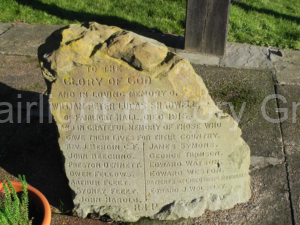
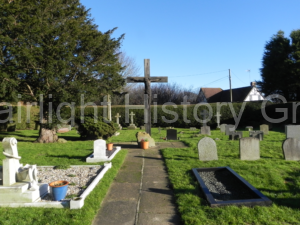
Additionally, at Fairlight, to the south of St. Andrew’s church and the Church of England graveyard, there is another smaller section of graveyard. This separate graveyard is dedicated to Roman Catholic burials and in the centre is a large wooden cross with a large inscribed stone at its base. To the casual observer this might mistakenly be taken to be the Fairlight memorial, but it is not.

The cross and stone were not always located here. In fact the Roman Catholic section of graveyard at Fairlight is a fairly recent development. The stone and cross were moved from the top of Chick Hill where they had been located in the grounds of Fairlight Cottage and the Roman Catholic Chapel. The Lucas-Shadwells had converted to Catholicism in 1902 and when they built Fairlight Cottage in 1906, the building contained its own private chapel. A few years later, a separate chapel was erected at the eastern end of the plot, on the edge of Chick Hill. (Fairlight Cottage has since been renamed The Down House, whereas the chapel has not been in service for many years and the property is now known as More Cottage).

Following WW1, Mrs Beatrice Lucas-Shadwell, who lost her husband William Peter to illness in 1915, decided that she should recognise the victims in Pett. Accordingly the cross and stone were erected in her grounds at Chick Hill. Interestingly the names remembered on the stone are mostly a separate list of names from the main Pett stone cross memorial, subsequently erected outside St. Mary and St. Peter’s church. The Lucas-Shadwell inspired stone was unveiled in May 1920 with great pomp and ceremony as reported in the Hastings and St. Leonards Observer. The main Pett stone cross memorial was dedicated later that same year, in December, and contains the comprehensive list of the victims of Pett.

The Lucas-Shadwell stone, now located at Fairlight is inscribed accordingly:-

“To the Glory of God and in loving memory of William Peter Lucas-Shadwell, of Fairlight Hall – died 1915-and in proud and grateful memory of those who gave their lives for their country, 1914-1919: Rev. John Burgiss C.F., John Beeching, Preston Dennett, Owen Fellows, John Harold, Reginald Jenner, Arthur Fleet, Sydney Fleet, James Symons, George Thomson, Edward Watson, Edward Weston, Patients of Cincu Hospital Roumania, Edward J Wolseley.”.

With the exception of Sydney Fleet, none of these people are named on either Pett or Fairlight memorials. Although we have started to research these names, any connection with Pett or Fairlight is unknown. However, we know that Captain William Noel Lucas-Shadwell was in service in many locations, including Roumania and Russia whilst his sister, Violet Belt, was a volunteer nurse in Roumania.

The principle Pett memorial, an engraved stone cross, is located outside St. Mary and St. Peter’s church and lists victims of both wars. Additionally Pett has wooden memorial boards inside the church, also for both wars, whereas there is another wooden plaque inside the Methodist church but for the WW1 victims only. The boundaries between the parishes of Fairlight and Pett have changed many times over the years and accordingly some of the victims were associated with both parishes and, in some cases the same man is remembered more than once on the different memorials eg. Henry Beeching, Albert Cox, Henry Barnes and George Glazier. In fact the Barden family, are generally remembered as being from Pett when in fact they were within the original Fairlight parish boundary at the time of both wars. As a result, I found it constructive to study the victims of both parishes when compiling the detail necessary for these articles.

The End.

If anyone has additional information relating to any of the above or knows of the family or friends of any of the victims can they please contact me (details at the front of the magazine). We know that some descendants still live in the area and we would like to hear from them. For further reading, can I suggest that readers refer to appendix 2 in Haydon Luke’s book ‘Fairlight, a Sussex Village by the Sea’.

By Paul Draper.


The Fairlight Victims of WW1 and WW2 and our War Memorials – Part 3

An article in four parts by Paul Draper published in Fairlight News in 2018


Part 3 – The WW2 victims associated with Fairlight and how they are remembered

In the previous magazines we introduced the subject of our victims from both wars and have looked at WW1 and all those men associated with Fairlight.

Inside St. Andrew’s church we have three plaques to our victims, one for WW1 victims, another for WW2 victims and a third, for one man, Hubert Samuel Alston Turner who died on 31st July 1917 in Flanders.

As we can see the WW2 plaque inside St. Andrew’s names four men. Additionally there is one WW2 CWGC gravestone, for Private Peter Gabbitas of the Royal Sussex Regiment.

The four men named are:-

1) Sergeant W. Op. Henry Lewis Barnes, 1382125 158 Sqdn., Royal Air Force Volunteer Reserve, who died 27th April 1943, aged 34, son of Henry and Louisa Rose Barnes of Fairlight Cove.

He is remembered at Rheinberg War Cemetery.

2) Sergeant Cyril Leslie Cruttenden, 977000, 90 Sqdn., Royal Air Force Volunteer Reserve, who died 21st April 1943.

He is remembered at Svino Churchyard.

3) Fusilier George Edward Glazier, 6410829, 11th Bn., Royal Scots Fusiliers, who died 28th August 1944, aged 19. He was the son of Samuel George and Sarah Mercy Glazier of Fairlight.

He is remembered at St. Desir War Cemetery.

4) Private Frank Message, 6412418, 1st Bn., East Surrey Regiment, who died 16th January 1943, aged 27. He was the husband of Dorothy Irene Message of Fairlight.

The above four men, from or associated with Fairlight, are all listed on the WW2 plaque inside St. Andrew’s, but another man is buried at Fairlight with a CWGC gravestone:-

5) Private Peter Gerald Gabbitas, 6408494, 70th Bn., Royal Sussex Regiment, who died 27th January 1941.

The CWGC state that he is remembered at Fairlight (St. Andrew’s) Churchyard.

(We are still investigating this, but records suggest that he died after falling from the cliffs near the Fairlight Glen minefield)

Additionally, a recent search of the online CWGC records has revealed a further seven men stated as being from Fairlight who lost their lives in WW2.

The seven further men are:-

6) Squadron Leader Arthur Marsden Lewis Alderton, 40066, 21 Sqdn., Royal Air Force, who died 21st January 1944, aged 24. He was the son of Ada D G W Alderton (nee Lewis) and husband of Kathleen Cameline Alderton of Fairlight.

He is remembered at Runnymede Memorial.

7) Lt. Col. John Dennis Francis Armstrong, 133116, Royal Army Medical Corps, who died 6th December 1944, aged 32. He was son of Richard Drake and Bertha Armstrong and husband of Suzanne Joan Armstrong of Fairlight, B.S., M.B., L.R.C.P., M.R.C.S.

He is remembered at Taukkyan War Cemetery.

8) Sapper Douglas Victor Barden, 2075180, 262 Field Coy., Royal Engineers, who died 25th April 1940, aged 19. He was the son of Thomas and Rosina Barden of Fairlight.

He is remembered at Dunkirk Memorial.

9) Private John Barden, 5350272, 10th Bn., Royal Berkshire Regiment, who died 19th January 1944, aged 25. He was the son of Charles and Hannah Barden of Fairlight.

He is remembered at Minturno War Cemetery.

10) Major Robert Peel, 79754, 11th Indian Div. Sigs., Royal Corps of Signal who died 28th February 1942, aged 28. He was the son of Mr and Mrs A L Peel of Fairlight.

11) 2nd. Lt. Edgar Frank Skyrme, EC/3759, 3rd Bn., 16th Punjab Regiment, who died 12th December 1941, aged 22. He was the son of Harold Edgar and Ethel Mary Skyrme.

He is remembered at Singapore Memorial.

12) Lt. Richard Henry Francis Truman, 148410, Royal Artillery, who died 16th June 1943, aged 32. He was the son of Herbert Charles and Edith Dorothy Truman of Fairlight and husband of Joan Margaret Truman.

He is remembered at Kanchanaburi War Cemetery.

George Edward Glazier, Douglas Victor Barden and John (Jack) Barden are also commemorated on the Pett War Memorials.

The WW2 plaque inside the church was apparently only erected in about 1992. Why only four men were named is not obvious. The additional eight men were also from or closely associated with Fairlight and I believe should be remembered here in Fairlight. We do have some photos and newspaper articles on some of the above men. Whilst we have such information for some, we do not for most and so, to be even, I am not including this. However, we have a photograph of the Pett Cricket Club taken at the time of the start of WW2. Sadly three of the men in this photograph lost their lives in the war and each of them was from Fairlight. They were Henry Lewis Barnes (back row, 3rd from right and Club Captain), John (Jack) Barden (with bat) and Douglas Barden (with ball). All three men were related. There are further members of the Barnes and Barden families in the photograph.

If anyone has additional information relating to any of the above or knows of the family or friends of any of the victims can they please contact me (details at the front of the magazine). We know that some descendants still live in the area and we would like to hear from them. For further reading, can I suggest that readers refer to appendix 2 in Haydon Luke’s book ‘Fairlight, a Sussex Village by the Sea’.

To be continued.


By Paul Draper.


The Fairlight Victims of WW1 and WW2 and our War Memorials – Part 2

An article in four parts by Paul Draper published in Fairlight News in 2018


Part 2 – The WW1 victims associated with Fairlight and how they are remembered

In the previous magazine we introduced the subject of our victims from both wars. This time we will look at WW1 and all those men associated with Fairlight.

Inside St. Andrew’s church we have three plaques to our victims, one for WW1 victims, another for WW2 victims and a third, for one man, Hubert Samuel Alston Turner who died on 31st July 1917 in Flanders.

As we can see the main plaque names nineteen men, including 2nd Lt. Turner, who has the above separate plaque from his family.

The nineteen men are:-

1) Private Charles Gilbert, 2204 West Kent Yeomanry (Queen’s Own), who died 31st August 1916. He is remembered at Thiepval.

2) Ordinary Seaman Frank C Cook A B, J/17465 H.M.S. Bulwark, Royal Navy, who died 26th November 1914 aged 18, son of Albert and Elizabeth Cook. He is remembered at Portsmouth Naval Cemetery.

3) Private Henry Charles Beeching, 1716, 2 Bn. Royal Sussex Regiment, who died 26th August 1915, aged 26, son of Luke and Ellen Beeching of Pett Road, Fairlight.

He is remembered at Vermelles British Cemetery.

4) Private L Osborne, 11388, 1st Bn. Coldstream Guards, who died 7th July 1916 aged 20, son of Anthony and Fanny Osborne of Black Brooks, Guestling.

He is remembered at Essex Farm Cemetery.

5) Boy 2nd class Jesse George Dadswell, J/53152, H.M.S. Ganges, Royal Navy, who died on 16th August 1916, aged 15. Jesse died of pneumonia in Shotley, Suffolk, England and is remembered with a CWGC stone at Fairlight, near the entrance to St. Andrew’s.

6) Private Peter James Harrod, 7743, 9th Bn. Royal Sussex Regiment, who died 15th August 1916, aged 22, son of Benjamin and Martha Harrod of Middle Road, Ore.

He is remembered at Delville Wood Cemetery, Longueval.

7) Major Alfred John Martineau, 19th Siege Bty, Royal Garrison Artillery, who died 17th April 1917, aged 46. He was the son of Alfred and Maria Martineau and husband of E. Louisa Martineau of 6 Evelyn Terrace, Brighton. (a descendant of the Martineau family of Fairlight Lodge).

He is remembered at Bully-Grenay Communal Cemetery, British Extension.

8) Able Seaman Leonard John Burton, Sussex Z/413, Hood Bn. R.N.Div., Royal Naval Volunteer Reserve, who died on 22nd April 1917.

He is remembered at Dulsans British Cemetery, Etrun.

9) Private Reginald James Marchant, TF/201997, 4th Bn. Royal Sussex Regiment, who died 4th May 1917, aged 19, son of Albert and Emily Marchant of Church Farm, Fairlight.

He is remembered at Savona Memorial. (His brother, Albert, also died in action – see below).

10) Private Albert Henry Marchant, 240660, 1st/5th Bn. Royal Sussex Regiment, who died 30th April 1918, aged 24, son of Albert and Emily Marchant of Church Farm, Fairlight.

He is remembered at Granezza British Cemetery. (His brother, Reginald, also died in action – see above).

11) Serjeant George R Suters, 201407, 2nd/1st Bn. London Regiment (Royal Fusiliers), who died 16th June 1917.

He is remembered at Arras Memorial.

12) 2nd Lt. Hubert Samuel Alston Turner, 2nd Bn. Yorkshire Regiment, who died 1st August 1917, aged 20, the only son of Herbert and Geraldine Turner (a descendant of the Martineau family of Fairlight Lodge). He has a separate plaque at St. Andrew’s.

He is remembered at Ypres (Menin Gate) Memorial.

13) Private Charles Kemp, G/17960, 13th Bn. Royal Sussex Regiment, who died 31st July 1917, aged 34, son of Charles and Kezia Kemp.

He is remembered at Buffs Road Cemetery. (Fairlight residents visited his grave in 2014).

14) 2nd Lt. Pruett Mullens Dennett, 208th Sqdn, Royal Air Force, who died 2nd June 1918, aged 19. He was son of Mrs E L Sandy (formerly Dennett) of 71 Preston Road, Brighton and the late R M Dennett.

He is remembered at Arras Flying Services Memorial.

15) Private William Victor Long, 245369, West Kent Yeomanry (Queen’s Own), who died 31st August 1916.

He is remembered at Thiepval Memorial.

16) Driver Albert Cox, 141035, 68th Field Coy. Royal Engineers, who died 15th January 1918, aged 32, grandson of Jesse Cox of Cecil Cottage, Pett Level Road. (His name is engraved on the gravestone of Jesse Cox, near the entrance to St. Andrew’s).

He is remembered at Boulogne Eastern Cemetery.

17) Lt. Charles William Jemmett, 5th Bn. The Buffs (East Kent Regiment) who died 15th March 1918, aged 32. He was son of William Francis Bond and Edith Jemmett of Ashford, Kent and husband of Dorothy Elizabeth Cotterell (formerly Jemmett) of Sussex House, Winchester.

He is remembered at Brissay-Choigny Churchyard.

18) Private F R Burton, 4013, 3rd Bn. Australian Infantry, A.I.F., who died 18th September 1918.

He is remembered at Villers-Bretonneux Memorial.

19) Captain Alexander Gordon Wynch Murray M.B.E., T.F. Adjt. Staff School (Cambridge), Officers’ Training Corps, who died 15th February 1919, aged 34. He was son of Alexander Elder and Mary Charlotte Irene Murray.

He is remembered at Walmer (St. Mary) Old Churchyard, Kent.

Albert Cox and Henry Charles Beeching are also commemorated on the Pett War Memorials.

The above nineteen men, from or associated with Fairlight, are all listed on the WW1 plaque inside St. Andrew’s, but two more men are buried at Fairlight with their families and the CWGC attend their graves:-

20) Captain Robert Cecil Burton, 2nd Bn. Rifle Brigade, aged 32 who died 16th March 1915, son of Mrs E A Burton of 18 Mansion Place, Queen’s Gate, London. The family grave inscription states “Died at Boulogne of wounds received at the Battle of Neuve Chapelle, France”. The burial register gives address as St. Leonard’s Lodge, St. Leonards-on-Sea.

The CWGC state that he is remembered at Fairlight (St. Andrew’s) Churchyard.

21) Lt. Stuart Underwood Baily, 490th (Home Counties) Field Coy. Royal Engineers, who died 15th September 1918, aged 32. He was son of Cornwallis and Marion Baily of 6 Dane Road, St. Leonards-on-Sea. The CWGC state that he is remembered at Fairlight (St. Andrew’s) Churchyard.

Two other brothers, William Guy Lloyd-Worth and Frederick John Lloyd-Worth, are also associated with Fairlight. The records show that their family were from French Court Farm which, at that time, was located in the enlarged Fairlight Parish. Frederick is remembered at Lone Pine Memorial, but William, who died only in February 1921, is remembered at Netley Military Cemetery.

Finally, there are more names mentioned on the independent memorial stone in the Catholic section at Fairlight. I will look at these in the final part of this series.

We do have some photos and newspaper articles on some of the above men. Whilst we have such information for some, we do not for most and so, to be even, I am not including this, except for the youngest victim. Jesse Dadswell stands out as being only 15 years old and in fact, never left these shores, dying from pneumonia at the land-based H.M.S. Ganges training establishment in Suffolk. His family worked at Fishponds Farm, Barley Lane and lived at Tile Kiln Cottages, both then part of Fairlight Parish, and his nephew, Chris, and other family are still based locally. They have supplied some information for us to share.

If anyone has additional information relating to any of the above or knows of the family or friends of any of the victims can they please contact me (details at the front of the magazine). We know that some descendants still live in the area and we would like to hear from them. For further reading, can I suggest that readers refer to appendix 2 in Haydon Luke’s book ‘Fairlight, a Sussex Village by the Sea’.

To be continued.


By Paul Draper.

The Fairlight Victims of WW1 and WW2 and our War Memorials – Part 1

An article in four parts by Paul Draper published in Fairlight News in 2018


Part 1 – How and where do we remember our fallen in Fairlight?

On the 11th November this year the country will remember the one hundredth anniversary of the ending of WW1 hostilities. All across our country, each community will celebrate the event in their own separate ways. It would appear that following the end of both WW1 and WW2 each community sought to remember those local men who had given their lives for their country. However the style and size of each memorial and the list of those men remembered was left to the communities to organise. As a result it seems that the memorials are a little inconsistent when studied carefully.

So what do we have in Fairlight and where are the memorials? The answer is inside St. Andrew’s church where we find three marble plaques mounted on the wall, next to the organ, remembering victims of WW1 and WW2. The WW1 plaque lists nineteen men and the WW2 plaque lists just four men. (see below). The third plaque is to one man, 2nd Lt. Hubert Samuel Alston Turner, erected by his family.


(It is somewhat confusing but next to St. Andrew’s church and graveyard, on the southern boundary is a small piece of land dedicated to and operated by the Catholic church. This is totally separate from the Church of England’s St. Andrew’s church and its graveyard. In the Catholic cemetery is a large wooden cross with an engraved stone at its base. Although at first glimpse this appears to be the Fairlight memorial, it is not and in fact was only moved there from Chick Hill, Pett when their small Catholic church was closed and the associated land deconsecrated. I will expand on this later.)

In addition to the two plaques inside St. Andrew’s we have a further four graves in the churchyard that are attended to by the CWGC (The Commonwealth War Graves Commission). Two of these are commemorated with the standard CWGC white stones, one from WW1, Jesse G Dadswell AB, and one from WW2, Pte Peter Gerald Gabbitas. The other two CWGC victims, Lt. Stuart Underwood Baily and Capt. Robert Cecil Burton, are simply remembered on their existing family gravestones. Of these four, only Jesse Dadswell is also remembered on the marble plaques. I cannot see a direct reason for these apparent inconsistencies.

However, further research has revealed that Fairlight had more victims than the total of twenty three names that appear on the two plaques plus the three additional men mentioned above who are remembered by the CWGC. Why were these other names not included? It will be impossible to find out all the facts so I will simply list the details of the additional victims as today we cannot put ourselves in the shoes of those who helped create the memorials. I will not go into the full detail of our victims, including the additional names, in this opening article but will expand on this subject in the following articles.

In March 2018 the CWGC added a discreet plaque to the front gates of St. Andrew’s advising visitors that the graveyard contains CWGC graves. In fact the CWGC have just implemented this policy across the entire country as a guide to all visitors.

In the next article, we will list the full names and details of all the Fairlight WW1 victims, including those who have so far not been included. Similarly, after that we will study the victims and memorials of our WW2 victims. Finally, we will look at the Catholic memorials and the overall situation with our neighbouring Parish of Pett as there is some overlap between our Parishes and, as a result, some men are named in both Fairlight and Pett.

If anyone has additional information relating to any of the above or knows of the family or friends of any of the victims can they please contact me (details at the front of the magazine). For further reading, can I suggest that readers refer to appendix 2 in Haydon Luke’s book ‘Fairlight, a Sussex Village by the Sea’.


To be continued.


Paul Draper.

Fairlight Garage

By Paul Draper

Did you know that we in Fairlight used to have a garage and petrol filling station? Located on the west side of the junction between Battery Hill and Waites Lane, the garage had existed from the earliest development of Fairlight Cove, in 1923 until its demolition in 2004. Now there are no clues as to its existence and four new properties stand on the old site, two in Waites Lane and two in Battery Hill.

The garage was a ‘proper’ garage offering repair shops, storage facilities, petrol pumps and local buses were also stored there. Indeed most of these facilities survived until 2000 when the final owners, Pat and Sue Trueman, were forced to sell up. Pat and Sue were popular local characters and are still in contact with many people from our village. They have kindly supplied me with copies of some early black and white and later colour photographs and some paperwork showing how different matters were in the early years. Additionally, a former local researcher, Jeanne Whiting, delved into the timeline of the many different owners and her work has proved invaluable.


An early view outside the repair shop. Note the old Tilling Stevens bus/charabanc.

After the 1917 auction of the Waites Farm Estate there were many owners of the lands now known as Fairlight Cove and finally in 1923, Mr Philp, a familiar name to many of us, sold the plot to the business of D.M.S. Ltd. Clearly they built the garage and started the business but in 1925 they sold on the business to a Mr. Biden. Over the pre-war years the ownership changed many times but from 1927 a Mr W.C. Davis took over and was a familiar name until 1938 when Mr. Archibald Lea took over. Mr. Lea was obviously very much a local character and as well as being the first owner of our Post Office and General Stores, he was also a local Preacher, practicing from a small Chapel in Chapel Lane, Guestling. The latter building is still there but has long been a private dwelling.

Another early view. To think that we complain about our road surfaces!

In 1953 a Mr. Lavender owned the business for a few years. He made one significant contribution to our local history. He gave a small portion of his land for the bus shelter to be built. If you look now you can still see the indentation on the western boundary into which the shelter was fitted and has remained ever since.

In 1958, a Mr. E. Gamet, known as ‘Gam’, took over and eventually passed it to his brother-in-law, Pat Trueman, so they were the last family to operate the facility.


Pat and Sue Trueman the last owners of Fairlight Garage.

We do not have details of when the garage was modernised but in its latter days, under the brand names of Jet and finally Murco, it looked like so many of those small local petrol stations that were so familiar to us all. They have all gone and now we have to use the much larger, faceless filling stations attached to Tesco, Sainsbury’s, BP and others.

A Bullnose Morris being refilled at Fairlight Garage. (Photo Keith Miller)

Sadly it came to an end in 2004 when the bulldozers moved in. Some local residents opposed the proposal for new houses but without success and the result of this was a small, four house development completed by Gem Select.

We have a small collection of photographs, old and new that we would be happy to show you. However, if any of you have any photographs or information, please let us know.

By Paul Draper.

Fairlight and the Amy Johnson Connection

By Haydon Luke

I am writing this in January 2016 close to the date, 75 years ago, when the famous flyer disappeared on a wartime flight over the Thames Estuary. Amy Johnson was a superstar in her own time, celebrated for a series of courageous and record-breaking long distance flights in the 1930s.

She was born on 1 July 1903, in Hull, where she lived until, in 1923, she went to Sheffield University and gained a BA in Economics. After graduation, she moved to London, working as a secretary to a solicitor, and became interested in flying which she followed up at the London Aeroplane Club in the winter of 1928-29. What had begun as a recreation soon became an all-consuming determination to prove that women could be as competent as men in a hitherto male-dominated field.

Her first important achievement, after flying solo, was to qualify as the first British-trained woman ground engineer, the only woman in the world to do so at that time.

Early in 1930, she set her first objective – to fly solo to Australia and to beat the existing record of 16 days. She had problems financing her planned journey but eventually her family and supporters raised the £600 purchase price of a used plane, a De Havilland Gypsy Moth (G-AAAH), which was named “Jason” after the family business trademark.

Amy Johnson and Jason in Jhansi, India in 1932.


Amy set off alone from Croydon on 5 May 1930, and landed in Darwin on 24 May, a flight distance of 11,000 miles. She was the first woman to fly alone to Australia, and came home to the UK to a hero’s welcome which culminated in her award of a C.B.E.

The Fairlight connection came a year later in May 1931 when, as a famous and unexpected visitor, Amy Johnson almost literally ‘dropped in’ to the Fairlight Cove Hotel for tea. According to the Hastings Observer of 30 May, the celebrated flyer was taking a Whitsun ‘flip’ in her Puss Moth aeroplane Jason II over Kent and Sussex.  So attracted was she by the evident beauty of the countryside that she decided to land. 
The field she landed in was owned by Flying Officer Tindall, late of the RAF, who told the newspaper:

“Miss Johnson made a perfect landing. She arrived here shortly after 5 p.m. Unfortunately, there were not many people about at the time, though if I had known she was coming I would have had a good crowd to welcome her.

She strolled down to the Fairlight Bungalow Hotel for tea and then wandered about the lanes picking bluebells. She told me she was delighted with Hastings and will probably come again.”

And she did. Partly as a consequence of pioneering flights by Amy Johnson and others, the 1930s was a time when aviation captured the popular imagination. The aviators were as famous then as footballers, pop performers or film stars today. The day she returned and landed her biplane in the field behind Church Farm led to an exciting period when Fairlight hosted air displays and flying circuses, much to the delight of many (but not all) members of the public.

Alan Shearer, whose family it was that farmed Church Farm in those days and lived in Church Farm Cottage, tells that bit of the Amy Johnson story.

“She came into the cottage with her boyfriend (later her husband) Jim Mollison and conferred at some length with father.  Obviously the meeting had been pre-arranged and for the next two or three years, in conjunction with Sir Alan Cobham, and a variety of aircraft and pilots, Fairlight was treated to an air display, stunt flying and personal flights around the locality at 5/- each.”  (Shearer, Alan, One Hundred Years in Fairlight, published originally in the Parish magazine.)
These events did much to popularise flying and to bring home to the public the way in which aircraft were developing.  Sensing an opportunity for itself, the Hastings Observer was quick to give these events some free publicity and offered 20 free flights to lucky readers – not in Amy Johnson’s plane but in a Handley Page ‘Clive’ air liner when Cobham’s ‘National Aviation Days’ first came to Church Farm on 20 and 21 August 1934.  Other flying displays followed later in the 30s.
But all too soon the peacetime skies were replaced by the formidable realities of World War 2, with Fairlight prominent.  The radar station RAF Fairlight played a crucial role in the Battle of Britain and again in 1944 when south east England suffered the V1 flying bomb onslaught.
By that time, sadly, Amy Johnson herself had become a casualty of the war.  She had joined the Air Transport Auxiliary (ATA) when the war began.  Nominally a civilian organisation, the ATA’s pilots’ main role was to deliver aircraft from the factories to the operational RAF stations as well as ferrying stores and personnel.  For this work the ATA needed experienced flyers and so recruited pilots who were unsuitable for the services by reason of age or fitness. They were sometimes humorously referred to as “Ancient and Tattered Airmen”.  The ATA also took pilots from neutral countries and, notably, women; one in eight of all ATA pilots, 166 in all, were women.
Amy’s last flight has become surrounded by an aura of mystery and suspicion, especially as to the purpose of her flight and what caused its tragic end.  Was she on some sort of secret mission?  Was there a mysterious second person on her aircraft?  Was her aircraft the victim of a calamitous ‘friendly fire’ incident?
What certainly is known is that it was whilst flying a mission for the ATA, on 5 January 1941, that Amy crashed into the Thames Estuary.  Despite the efforts of the crew of convoy escort trawler HMS Haslemere who had spotted Johnson’s parachute coming down and saw her alive in the water, calling for help, rescue proved impossible.  Conditions were poor – there was a heavy sea and a strong tide, snow was falling and it was intensely cold.  Lt Cdr Walter Fletcher, the 34 year old commander of Haslemere, bravely dived into the water in a rescue attempt.  Tragically, he failed and later died in hospital. According to The Times account, Amy disappeared beneath the water before further rescue attempts could be made.  Her body was never recovered.  A Memorial Service for her was held on 14 January 1941 at the church of St Martin in the Fields in London. 
In her obituary in The Times on Wednesday 8 January 1941, her commanding officer in the ATA said of her: “In her private life [she] was unassuming and entirely lacking in conceit. It is inevitable that the name of someone as famous as she was should be coupled with many extravagant stories. Those who knew [her] intimately saw her as an ordinary human being, keen on her job, brilliantly successful but always accessible….Those that knew her have lost the type of friend who cannot be replaced.”

By Haydon Luke

Fairlight Sand Quarry

By Haydon Luke

Quarrying is an activity which has a long history in Fairlight. Sandstone quarries can be seen either side of the road leading up from Ore, and St Andrew’s Church itself was constructed from locally quarried stone. Farmers, too, have made extensive use of local stone to construct farm buildings throughout the district. Small quarries or stone pits are a common feature of the local landscape.

In the 1920s a particularly fine kind of sand was identified in the local rock not far from the Church, and later the exigencies of wartime led to it being exploited extensively by a mining company. Fifty years later, in the 1980s, the local residents were shocked to discover that a major oil company was proposing to do test drilling in the Fairlight area. In the event, both activities were short lived. However, both have left their mark on the landscape and are reminders of how easily the rural tranquillity of Fairlight could be compromised.

So where were these sites and how did it all come about? Few of those who use the Country Park car park off Lower Coastguard Lane, adjacent to the public toilets and across from the Coastguard Tea Room, are aware that they are standing on a former industrial site.

The picture below shows the extent of the site in 1965. Coastguard Lane is at the right with the corner of St Andrew’s Churchyard in the top right hand corner. The area where the main processing buildings can be seen is now the large car park by the public toilets. The main quarry is at the bottom of the picture and covered a large area which is now heavily overgrown. A second large area was opened up further to the south west of the main site towards Warren Cottage. Material was conveyed to the processing area near the church by small trucks on rails approximately half a metre in gauge pulled along by a constantly running overhead drag a bit like a ski button lift.

The sand quarry story seems to begin in the 1920s. In the period after the First World War, Hastings, in common with many big towns, had a problem finding work for the unemployed. There was a discussion in the local Employment Committee and the suggestion was made that because there was known to be a high quality source of white sand in the Fairlight quarries (the sandstone from which had previously been used for building) perhaps a glass-making industry could be established locally to produce glass for the optical industries. However, it was pointed out that, as well as a highly skilled work-force, glass making required large quantities of coal to fire the furnaces. Bringing in coal and training up the work force would be costly, so starting a Hastings glass industry from scratch was declared a non-runner. An alternative, however, might be to exploit the sand to supply the already established British glass manufacturers. The reserves of suitable sand in the Fairlight quarries were estimated at 15 million tons. (Source; HSLO, 11 September 1920).

Some time later, a small operation was set up in the quarry near Fairlight Church.  This picture, from the British Geological Survey and taken on 1 May 1926, shows the quarry in operation, with St Andrew’s Church unmistakably in the background.  The quarry was producing ‘glass-sand’ which at the time was used in making scouring-soap, and clay for bricks.   This is almost the same view as on page 5.  The Kelly’s Street Directory for 1928 has an entry listing British Sands Ltd., with a business address of Sandworks, Church Farm, Fairlight.

The quarry was still running in 1928 when the same newspaper carried the story of a “Quarry Worker’s Marvellous Escape.” The gist was that quarry worker, James Brann, had had a lucky escape from being killed by a falling boulder as he lay helpless beneath a mass of earth and rock which had subsided on him whilst he was working in the quarry. (HSLO, 21 April 1928). He suffered a broken leg and head wounds. Not much concern for Health and Safety at work in those days.

According to documents in the East Sussex Archives (SWA20/1/47 Fairlight Sand Quarry Project) the sand quarry story seems to gain momentum in 1933 when a local businessman, Captain R E Philp (who also had business interests in the housing developments in Fairlight Cove) sees a potentially money-making opportunity in the sand to be found in the ground to the south west of St Andrew’s Church. Up to this point 95% of the sand used in glass manufacture in the UK had been imported from Belgium. The Fairlight sand is suitable and of excellent quality and Captain Philp reasons that if he can extract it and transport it sufficiently cheaply then the domestic glass industry will be interested in obtaining it from him rather than from Belgium.

However, the Belgian sand industry enjoys subsidies and so to be viable the Fairlight sand will have to be extracted and transported as cheaply as possible. To this end Captain Philp conceives a cunning plan. On 1 March 1933 he writes to the Rother and Jury’s Gut Catchment Board (R&JGCB) with his proposal to send sand from the quarry he intends to open up at Fairlight out by sea from Rye Harbour. To keep costs down he proposes to transport the sand from Fairlight to the harbour “by means of an aerial ropeway, the establishment of a loading station, and the conveyance thence to destination by means of barges of not more than 500 tons capacity.” (Letter to R&JGCB from Capt. Robert E Philp, 01 March 1933).

Just think how the Fairlight landscape would have been affected had such a proposal materialised! The aerial ropeway, once constructed, would have low running costs and could operate if necessary around the clock. It would run from the quarry, roughly along the line of Warren Road, across the land Philp owns in Fairlight Cove and then down to Pett Level and across the Marsh. The plan of Rye Harbour he sends with his letters shows the ropeway line approaching to the south of Martello Tower No 28 (the one at the entrance to the holiday village by the access to what is now Rye Harbour Nature Reserve) and reaching a discharging bay into sand bins on the harbour side due east of the Martello tower. He estimates that the volume of sand to be exported would exceed 100,000 tonnes p.a.

In order to make his scheme viable Captain Philp needs to get the freight costs as low as possible and to that end he seeks to secure special low rates from the harbour board. Both the R&JGCB and the Harbour Committee are less than impressed with this and refuse to do a deal, despite the efforts of Captain Philp to persuade them that his scheme is in the national interest. Negotiations drag on and no progress is made. Finally, he has to admit that the scheme has faltered “owing to certain provisions in the Hastings Town planning Scheme, which materially affect the land under which this mineral lies.” (Explained by Philp in letter to R&JGCB June 24 1933). Also, by this time the Fire Hills have become a public amenity and the prospect of large scale mineral extraction with aerial ropeways is not likely to come about.

In the event, a much more limited level of quarrying takes place until the onset of war and then the loss of supplies from Belgium puts the sand extraction project into a different context.

Triumphantly announcing the launch of the later scheme put forward by a new company, the Fairlight Mining Company, in January 1939, The Hastings Observer emphasised the positive impact on employment – “Local Labour will be employed in the quarrying work and local men are to be trained for the working of the refining plant to be established at Doleham” – whilst playing down the environmental impact – “Practically nothing of the working will be visible from the cliff paths and no permanent buildings whatever are to be put up to mar the landscape, nor will any unsightly machinery be seen.” (HSLO, 14 January 1939).   The reality was a bit different – though far less damaging to the environment than Philp’s original scheme would have been.

So it was that later in 1939 some of the ground to the south west of St Andrew’s Church was leased out by the then landowner Major Carlisle-Sayer to the Fairlight Mining Company to be opened up for quarrying, and the crushing and refining plant was housed in buildings adjacent to Church Farm House. The sand rock extracted from the quarries in the area, when crushed and refined, provided a silica with a low iron content – the lowest in England according to Fairlight; Echoes of the Past. This made it suitable for the manufacture of very high quality glassware.

Thus, when imports from Belgium became impossible after the outbreak of war in 1939, the strategic importance of the Fairlight quarry rocketed. In the national emergency it was understandable that Hastings BC would approve giving the FMC limited rights to extract the sand, and the company and the landowner undertook to make the land into a public amenity afterwards. It is said that the glass made from the Fairlight sand was required for high quality optical items such as submarine periscopes, gun sights and binoculars as well as more general glass products.

Whatever the truth of that belief, at their peak the works employed over eighty men and six glass firms were supplied. A steady stream of lorries was needed to transport the sand to the railway sidings at Ore and this put pressure on what was then the only access – the narrow lane that runs between the churchyard and Church Farm House and out onto the Fairlight Road by the old school.

Controversy continued to haunt the sand quarry, however. It quickly became clear that better access was required for the succession of vehicles that were required to transport the sand. The Fairlight Mining Company consequently negotiated with the Hastings Council and the Church to create a new access – the road that later became Lower Coastguard Lane. Glebe Land was purchased from the Church in 1940 for £50 to improve the entrance from the Fairlight Road, and land from Church Farm was requisitioned to provide the road. The large area adjacent to the public toilets now used as car parking was the site of the processing plant.

In the 1950s the noise from the processing plant was so bad that it was disturbing lessons at the Village School only a short distance away. The Headteacher reported to the Managers (4 October 1950) “that the noise from the works at the Sand Pit was so great that it disturbed the school work”. The Managers wrote to Mr Hooley, Chairman of Cookes Sand Pit Quarries Ltd., about the noise but received no reply. Nine months later, in July 1951, the Managers wrote to the Chief Education Officer asking advice about the noise of blasting from the Sand Pit Quarry.

In the event, the quarry did not prove to have a very long life once the war was over. Various operating companies came and went, and people recall that by the 1960s the site was derelict and abandoned. This photograph, from the Fairlight archive, shows the buildings in course of demolition in the 1960s.

In 1963 the land held by the Fairlight Sand Quarry Company was registered to Hastings Corporation (later becoming part of the Country Park) and on 5 July 1966 the Fairlight Sand and Development Company Limited was finally struck off the register at Companies House having been wound up some time before.  The last entry for a quarry company at Fairlight in the street directory is in 1960/61.


The picture at left was taken in January 1967 by the IGS (now British Geological Survey) and shows the side of the old sand quarry and the depth of the ground excavated by the sand extraction. This view is looking NE at the basal Wadhurst Clay sandstone seen behind the human figure. The upper grassy slope is in shales and siltstones, and grass and shrubs have already reclaimed more than a foothold.  The area is now (2014) very heavily overgrown with vegetation and it is hard to grasp the full extent of the quarry workings.  Compare this picture with the one from 1926 earlier in this article.

This map from 1970 shows the extent of the sand workings at the end of their active life.

Drawing in papers at The Keep, ESRO DH/B 83/785/2/1-4 File 1 – Fairlight Place Farm including Fairlight Sand Quarry

The quarry area did not entirely drop from public view after sand working ceased. In the summer of 1969 Fairlight residents in Coastguard Lane and vicinity were shocked to find they were about to endure 10 weeks of round-the-clock drilling close to the Church, Church Farm House and the tea rooms. The Institute of Geological Science (IGS) which had been carrying out surveys in the district between Bexhill and Rye for some 4 years was about to mount an investigation into the rock formation between Cliff End and Hastings.

Although the purpose was chiefly to explore the exact nature of the strata beneath the sandstone, there was even the possibility that the boring might discover oil or natural gas. Had that been the case, Fairlight’s story might have been very different. With fracking moving up the national agenda who knows what might happen in the future?

Back in 1969 residents were naturally concerned about noise, vibration and the possibility of mishaps. A public meeting was hastily convened at the Church Café. At the meeting on 30 July Dr Shephard-Thorn, representing the IGS, was on the spot to explain the way the investigation would work. Ever vigilant, the Fairlight Residents’ Association took up the fight and wrote to the various authorities concerned. Their efforts bore some fruit and the IGS contractors were limited to 12 hour days and no Sunday working.

And finally a twist of fate caused them to be grateful that the IGS was working in the quarry. The residents of Coastguard Lane had campaigned for the demolition of the dilapidated quarry buildings during the 60s without success until winter storms in November 1969 caused severe damage and put the instruments of the IGS at risk. Because of the general damage to property and the danger to the Geological Survey, the owners of the quarry were forced into acting.

The Hastings Observer of 15 November 1969 reported houses “showered with debris” and said that “the Church Café and bungalow next door were worst affected by the collapsing roof. Pieces of timber and asbestos were flung into the café’s garden, narrowly missing customers who were outside.”

Debris, some including pieces of timber up to 15 feet long, were deposited on other properties including Church Farm House and into the churchyard itself.

The buildings were eventually demolished by Cole and Jennings & Co., Ltd., of Camber, the company who leased the quarry from Hastings Corporation after the Fairlight Sand Quarries Company ceased operations. Finally the site was cleared and the area became a car park for the Country Park when that was created by Hastings in 1970. So, with the exception of an on-going dispute (which still continues) about responsibility for the poor state of Coastguard Lane, the outcome was satisfactory for all.

The drilling by the IGS continued into the spring of 1970. The borehole was more than a mile deep, almost 1,800 metres from the surface, but the results yielded few surprises. The subsequent report mentioned slight traces of natural gas but not to the extent that would merit exploitation. Residents could rest easy again – until the American oil men arrived in the 1980s!

By Haydon Luke

St.Andrew’s Church Yard

By Paul Draper

Have you ever taken the time to walk around the old graveyard at St. Andrew’s? It is overgrown in places and very uneven, so you have to be very careful. However, it is well worth the visit as we have more than our fair share of celebrities and other important people. A majority of these people did not actually live in Fairlight so why are they buried at here you might ask? St. Andrew’s Church had been rebuilt in 1845/6 and with the arrival of the railways, it became fashionable for people from London to visit Hastings and St. Leonards to take in the fresh sea air and then visit the Firehills and the glens and walk up to visit our church. It seems that many of them liked the setting so much that they asked to be buried here.

The ’celebrities and worthies’ (people worthy of a mention) seem to have mostly appeared in the second half of the 19th century following the building of the new church and all under the stewardship of the Reverend Henry Stent. Henry Stent, Fairlight Rector from 1858 to 1903, despite his different surname, was the brother of William Drew Lucas-Shadwell (1817-1875) and uncle to William Peter Lucas-Shadwell (1852-1915). If you refer back to my earlier articles on the Lucas-Shadwells, published in Fairlight News between March 2016 and June 2017, you will understand the importance and influence of the family on our village.

Although the graveyard is uneven and somewhat overgrown in places it has been much worse. By 1994 certain parts were covered in brambles and weeds to a depth of five feet and more and hence nobody could fight their way through, particularly in the lower area to the east of the church. Frustrated by the worsening situation, a small group of volunteers set out to clear the area. After an organised few days of ‘slashing and burning’ they began to see the light. They then started to read some of the gravestones and tombs and realised that we had some important names buried here. As a result and after some research, a brochure was put together in 1995 and that has been available inside the church ever since.

Over the recent years, we have been continuing to read more gravestones and pages from the Fairlight registers and conduct more research. As a result we have discovered more interesting names and stories and, in 2018, decided to put together a simplified and modified short brochure to assist visitors. Below is an extract from the brochure:-

What connects President Franklin D Roosevelt,

Cecil Rhodes, T. S. Eliot, Richard d’Oyly Carte

and William the Conqueror?

Answer: The churchyard of St Andrew’s

in Fairlight, East Sussex!

The following are listed in an order that permits visitors to see each grave in order, in an approximate anti-clockwise direction:-

1 Richard d’Oyly Carte and his parents. Richard founded the eponymous d’Oyly Carte Opera Company and the Savoy Hotel.

2 The earliest legible gravestone dated 1740, in the name of John Gorham.

3 Thomas Farncomb & family. Thomas was Alderman of the City of London for many years and the Lord Mayor in 1849-1850. He assisted Prince Albert in his early preparations for the Great Exhibition of 1851. In August 2020, Hastings Museum and Art Gallery acquired the silver trowel with which Thomas, on 28th October 1850, inserted the closing bricks in two of the local tunnels of the Ashford, Rye and Hastings Railway.

4 Thomas Attwood Walmisley M.A., Mus.Doc. was a Professor of Music at Cambridge, a musical prodigy and master player of church organs. He composed church music and madrigals.

5 The Lucas-Shadwells of Fairlight Hall. They are remembered in the stained-glass windows’ in the Lych Gate and on many of the gravestones. Many other members of the family are to be found here plus three more in the Catholic section next door. William Lucas-Shadwell was MP for Hastings 1895-1902.

6 Sir Woodbine Parish KCH. British Diplomat. Best known for his work following the defeat of Napoleon and in Buenos Aires recognising Argentina as a state in the 1820s. He was buried at Fairlight in 1882 together with several members of his family.

7 Joanna Burdett third daughter of Sir Francis Burdett MP for Westminster for 30 years. Connected to the Coutts banking family.

8 General Sir Charles Menzies, aide-de camp to Queen Victoria and founder of Newcastle, NSW, Australia.

9 William, the 8th Earl Waldegrave, a direct descendant of William the Conqueror via Henrietta FitzJames, the illegitimate daughter of King James II. His widow, Lady Waldegrave, formerly Sarah Milward, gave the largest donation for building the current church (£I,000) and laid the foundation stone.

10 The parents and sister of Sir Cecil Rhodes, pioneer and statesman who gave his name to Rhodesia. Cecil Rhodes loved walking in Fairlight Glen. He did not marry. Cecil is buried at World’s View, Matobo National Park, Zimbabwe.

11 Frederick Ticehurst. JP and surgeon for 45 years in Hastings. He was Mayor of Hastings five times and surgeon to the 4th Cinque Ports volunteers. You might recognise the name as family member Richard Ticehurst has a ward named after him at the Conquest Hospital, Hastings.

12 The Sankey family. Percy gave land to the church in 1926 as a Rose Garden at the eastern end of the churchyard, now a graveyard extension. His son, Reverend John Sankey, founded the Old Hastings Preservation Society.

13 The Martineau family. A prominent family from Fairlight Lodge connected to the Whitbread brewers. The family includes the wife of Cyril Edgar Martineau, Muriel Delano Martineau, first cousin to US President Franklin Delano Roosevelt. Catherine Middleton, wife of Prince William, is a distant relation.

14 Sir James Roberts, Baronet JP, LLD. He made his fortune as owner of Saltaire, a model industrial community near Bradford. TS Eliot referred to ‘a silk hat on a millionaire’ in the poem, ‘The Waste Land’ after meeting him.

The above are the names in the present church information sheet. Further names will we added to this list and will include:-

-Members of the North family, who included a local MP and Marianne North, the botanist and artist after whom a gallery is named at Kew Gardens.

-James Scholefield, Professor of Greek at Cambridge Trinity.

-Admiral Cospatrick Baillie-Hamilton.

-Sir George Curzon Bisshopp, 11th Baronet of Parham.

-Mary Bonnet Capel Davies, daughter of James Capel of City Stockbrokers, James Capel & Company.

-Jack Frye, late husband of Lady Dashwood. Lady Dashwood, when previously known as Marla Landi, appeared in films including The Hound of the Baskervilles with Peter Cushing and Christopher Lee.

-Graeme Sutherland, the 7th Laird of Graemeshall, Orkney Islands.

-Frederick Henry Hamilton Smith, of the Barons Colwyn.

-Henry Hemans, grandson of Felicia Hemans. Felicia, a poetess, was probably best known for “The boy stood on the burning deck……..”

-Sir Charles Taylor, 2nd Baronet Hollycombe.

-The Hon. Maurice Richard Wingfield, of the Viscount Powerscourt family.

No doubt more names can and will be added to this list.

Clearly, we have more than our fair share of ‘important’ people. If we compare our Parish to our neighbours in Pett, they seem to have very few. It can only be attributed to our location with our amazing views across Rye Bay and the Channel. Sadly those views have been mostly obscured by trees in the 20th and 21st centuries.

We, the Fairlight History Group, had planned to give an expanded presentation on the ‘The celebrities and worthies of Fairlight graveyard’ on 18th March at the Village Hall. Sadly this was postponed due to Covid 19 restrictions and we will have to find a suitable opportunity to put this on in the future.

As usual, if you know anything further about any of the above people, or want to know more, please contact us.

By Paul Draper (September 2020)