Category Archives: Articles

The Story of Fairlight Residents’ Association – Part 1

An article in four parts by Paul Draper published in Fairlight News in 2017

The story of the Fairlight Residents’ Association

What were its origins and how did it develop

Part 1 – The origins:

This year, 2017, we will celebrate the first seventy years of the FRA, the Fairlight Residents’ Association, but how did it all start?

Shortly after WW2 ended, in 1947, the residents of Fairlight realised that they needed an association to look after the pressing local matters of the time. The most important matter seems to have been the need for compensation from the Military Authorities for the damage inflicted on all the local roads by the army and the other services. We will look at this story in greater detail, but first we need to look further back.

We, the FRA, are lucky enough to have not only the Minute book covering the years 1947 to 1951 but also for the years 1929 to 1938. How are there records from before the war? Well the book covering the years 1929 to 1938 is actually for an earlier association called the Fairlight Ratepayers and Residents’ Association, the FRRA!

We do not have the records for the FRRA from the beginning, but newspaper articles from the time tell us that this association was formed in 1924. The Minute book contains the minutes of each ordinary meeting during that period but does not contain the AGM minutes. Luckily for us the FRRA Secretary took it upon himself to send an outline report of each AGM to the local paper, the Hastings and St. Leonards Observer, and these records are still available. The first record we can find is in the year 1927 and it seems that the FRRA started with yet another name, but it was undoubtedly too long to remember, namely ‘The Fairlight Cove (Waites Estate) Ratepayers and Residents’ Association’. This latter name was only changed in 1928 to the then FRRA “in order that all ratepayers in Fairlight should be eligible to join”. In fact, yet another name was reported in the HSLO in 1926, namely the ‘Fairlight Property Owners and Ratepayers Protection Association’, but this name was unsubstantiated.

As can be surmised from the early names, the primary concern of this early association was to obtain a fair level of rates for residents of the new properties in Fairlight Cove and the rest of Fairlight parish. It seems that the proposed rate for our region were nearly double that for Hastings. Obviously similar differences were encountered across the county because the FRRA was obliged to join the Federation of East Sussex Ratepayers’ Associations. When this Federation aligned itself politically with the National Union of Ratepayers Associations, the FRRA faced strong objections and resignations and so voted to leave the Federation.

The first Chairman of the FRRA was Captain Francis Vernon Wilson (sometimes referred to as Commander). From what we can ascertain, Captain Wilson was an influential character in the early days of Fairlight Cove. It seems that following the Fairlight Hall Estate sales in 1917 and the subsequent rapid change of ownership of the lands of Waites, Wakehams and Warren Farms over the first few years, it was Captain Wilson who purchased Waites Farm and set about the development of this part of Fairlight Cove. He lived at Waites Farm until he moved away in 1931 and died later that year. He passed the ownership of his properties to his family, notably his younger siblings and it was they who continued the development of the estate. Many of you will probably find their names in your deeds or in the early covenants covering your land.

Anyway, when we look at the subjects covered by those early minutes it seems that nothing changes. The problems seem very familiar, namely cliff erosion, the state of the roads, unmade in those early days, drainage and the telephone kiosk at the Post Office.

We do not have records after 1938, but we must conclude that the FRRA stopped functioning during WW2 and when it was revived after the war, it was relaunched as the Fairlight Residents’ Association in 1947.

In the next part we will look at the formation of the FRA and the early issues of the village.

By Paul Draper.


The Story of Fairlight Residents’ Association – Part 2

The story of the Fairlight Residents’ Association

What were its origins and how did it develop

Part 2 – 1947 and the early years:

This year, 2017, we are celebrating the first seventy years of the Fairlight Residents’ Association, the FRA. In part 1 of this story we looked at the FRRA, the earlier incarnation that had represented the residents up until the war years, but had then ceased. After WW2 ended, the residents of Fairlight realised that once again they needed an association to look after certain local matters of the time.

There was no FRA in 1946 but in 1947, many notable events hit the headlines, including Thor Heyerdahl crossing the Pacific in Kon-Tiki, the brand Ferrari S.p.A. was created and launched the 125S, the transistor was invented, the C.I.A. was founded, Princess Elizabeth married Philip Mountbatten, Duke of Edinburgh and Tommy Lawton was sold by Chelsea FC to Notts County for £20,000, the highest transfer fee in British football at the time. (see photos attached). Not making the news was the formation of the FRA in 1947.

We cannot find the very first minutes, but we have the first official Minute Book covering the period from 17th November 1947 until 20th April 1951. As we mentioned in part 1, the most pressing matter seems to have been the need for compensation from the Military Authorities for the damage inflicted on all the local roads by the army, the R.A.F. and other services. Indeed, the FRA would appear to have been created to act for the Fairlight Cove frontagers in claiming their share of the compensation in negotiations with the owners of the roads who were the recipients of the compensation. The early minutes are predominantly about the negotiations with the landowners and then deciding how to actually carry out the work to all the damaged roads utilising the net funds when they were paid to the FRA. We will detail some of this below.

However, there are some important facts to note from those early days. Firstly the initial annual membership was one shilling. Nominally, one shilling equates to £0.05. This seems a very low fee compared to the current £5, being exactly one hundred times more expensive, but when modern equivalency formulas are applied, the current equivalent purchasing power of one shilling appears to be anywhere from £1.58 to £8.96, depending on the basis of the calculation. £5 would therefore seem to be about the same in real terms.

In the beginning there was no regular newsletter or magazine. Despite this, annual membership fees had to be collected, but apparently this was proving a problem due to a shortage of volunteers. The solution was to introduce a fee for the ‘collectors’ as an incentive. According to the minute of 21st September 1949, each collector would henceforth be paid one penny for every one shilling collected. (Back then, they were not even carrying heavy bundles of magazines up and down the roads of Fairlight!). It seems that this system still did not do the trick because in 1950 the committee considered increasing the fee to two pence per shilling collected, but we do not know the outcome of that particular idea. We also do not know when fees were dropped altogether. (Does anyone remember?).

Another major difference in 1947 was where to meet and hold events. There was no Fairlight Village Hall in 1947, so the committee had to find suitable venues. It seems that routine committee meetings were held at the homes of individual committee members, such as, Stockdale, Waites Farm, Pinehurst, Thalassa and Stream End, but larger gatherings, such as AGMs or social events were held at The Barn, The Fairlight Cove Hotel and Quarry Hall, Church Lane. (Quarry Hall seems to have been part of the Fairlight Sand Quarry set up, located where the Firehills carpark and toilets are now). However, in December 1949 the first village hall appeared, after a few false starts, and ever since then it has acted as home to the FRA.

So, looking back at the state of the roads, the most important event of those early years, we see those very familiar words – pot holes. However, alongside these words we also see “cart ruts”, a problem we no longer have on our roads! In the late forties the roads were not nearly as good as our present billiard-table smooth roads! Many were unmade and after years of neglect and continued punishment from military vehicles something had to be done. Mr. Godfrey West, the solicitor acting for the road owners, is quoted as saying “The roads in question were never roads as such and were in a very indifferent condition in 1939”. The seven roads named were Waites Lane (from Fairlight Cove Hotel to the Haddocks), Broadway, Cliff Road, Rockmead Road, The Avenue, Smugglers Way and Sea Road. (nb This section of Waites Lane was later renamed Lower Waites Lane and Cliff Road became Cliff Way).

Accordingly, after protracted negotiations the Military Authorities agreed to pay £516 7s 9d to the owners of the Fairlight Cove Estate but the net sum to be made available by the owners to the frontagers was first mentioned to be £450 after their deductions. It seems that after talks between the owners and the frontagers were slow. After a time, it was agreed that the FRA would represent the frontagers and oversee the distribution of the monies in question. The final net figure paid over to the custody of the FRA was £300. Negotiations for the exact application of this money were contested and disputed all the way, but utilising local contractors and free local manpower the work was duly carried out.

Later the condition of the first section of Waites Lane and of Hill Road, following the operations at R.A.F.Grangewood (located on the southern side of Hill Road) also became the focus of FRA assistance. As the funds dedicated to the maintenance and repair of roads throughout all Fairlight were very limited, contributions were sought from frontagers and the FRA maintained separate accounts for the road repairs under three separate headings. The annual accounts of the FRA even as late as 1960 show these as separate items, namely, “Cove Roads” (the seven mentioned above), “Waites Lane” (the first section from the garage to the hotel) and “Hill Road”.

As the problems of the roads unravelled and the functions of the FRA became clearer, the familiar issues of our village began to emerge. Early minutes cover bus shelters, water supplies, seats on the cliffs, steps down to the sea and candidates for the Parish Council and for Battle RDC. The Post Office was often under discussion and many residents were pressing for sub-branches both in the centre of the Cove and near the church. Nothing became of these ideas.

Also found in the first minute book is the attached poster and newspaper cutting giving details of the first FRA social event, an “Informal Social Evening in the lounge of the Fairlight Cove Hotel” held on Friday the 1st December 1950.

We hope that the above snippets from 1947 and the formative years of the FRA give you some insight into those early post-war days and in part 3 we will look at the introduction of the Fairlight News and the increased role of the FRA in the development of Fairlight.


By Paul Draper.


The Story of Fairlight Residents’ Association – Part 3

The story of the Fairlight Residents’ Association

What were its origins and how did it develop

Part 3 – The FRA news sheets and magazines:

This year, 2017, we continue to celebrate the first seventy years of the Fairlight Residents’ Association, the FRA. In part 1 of this story we looked at the FRRA, the earlier incarnation that had represented the residents up until the war years, but had then ceased. In part 2 we looked at the FRA in the year 1947 and the immediate post-war period.

All members of the FRA know and love the quarterly magazine, the Fairlight News. The latest magazine consisted of forty eight pages, plus the cover pages, and is now produced in high quality print with several pages in colour. This was not always the case.

In the FRA archives we hold a large but incomplete collection of the magazines. The earliest we hold is dated January 1983 but is only numbered sixty nine. This means that the first sixty eight magazines are still needed for our collection. If we calculate backwards, assuming four issues per year, then the first Fairlight News was produced in January 1966. (If anyone has any of these first magazines and they are willing to share them, can they contact me on 814154 or anyone from the committee).

Until this month, July 2017, we believed that the FRA started with the magazine in !966. However, I have just been handed two double-sided sheets dated April 1964 under the heading “No.4 News Sheet”. This appears to be the forerunner of the magazine (see attached sheets).

The news sheet was handed over at the Gardening Club Hut by a kind resident who found it in his recently purchased house and noticed the article on the formation of the Fairlight Gardening Club (first meeting held 12th March 1964). We are very grateful.

There are many interesting stories and snippets of information to note. Firstly membership of the FRA is given as half a crown (numerically 12.5 pence). This was already a substantial increase from the original 1947 price of one shilling (5 pence). The AGM was scheduled for 6th May 1964 and on the agenda once again was a proposal to adopt a new Constitution.

It seems that there were many problems to deal with, particularly the “pest” who was stealing daffodils in bud from front gardens at 7.30 in the morning! Driving standards were more casual in 1964 as demonstrated under the heading of “The Circle” where the FRA were appealing to drivers to “keep left” at The Circle as drivers were taking a shortcut to Commanders Walk. It then quotes that “It is certainly contrary to the instructions contained in the Highway Code”! Hopefully this advice does not need repeating today.

On the subject of roads, Waites Lane and Shepherds Way were being reconstructed but the contractors were having problems with streams of water from the hills. The footpaths were yet to be constructed but when complete, East Sussex would be adopting these two roads with a promise that Broadway would follow. Meadow Way was only under construction at this time. Furthermore, motorists heading up Channel Way, Fyrsway and Bramble Way at night were being asked to turn off their headlights as they were dazzling the Coastguards Lookout at the top of the Firehills!

Other interesting articles from 1964 include the Fairlight Players having to cancel their production of ‘Roar like a Dove’ owing to “circumstances beyond their control”. Also, the problems encountered by the collectors of FRA subscriptions, as detailed in the last article were continuing. Often members did not have the money available and they had to be visited two, three or more times. (Speaking as a collector myself, it seems much easier today). The shop previously run by Mr. Rimmington had been taken over by the Misses Graydon and Butterfield and was to be known as the Woolpack. (The building remains today, but is now a private residence).

Finally from the 1964 article we are told that the new Hastings lifeboat, named ‘Fairlight’ was about to be handed over. The vessel was built by William Osborne of Littlehampton, of the type known as ‘Oakley’. The vessel is 37’ long, with 12’ beam, weighs 12 tons and runs up to 9 knots with power from two 43hp diesel engines and will carry up to 40 people.

We hope that the above snippets from the formative years of the FRA give you some insight into those early years. In the final part we will look at the FRA today and in the most recent years.

By Paul Draper.

The Story of Fairlight Residents’ Association – Part 4

The story of the Fairlight Residents’ Association

What were its origins and how did it develop?

Part 4 – The modern era:

This year, in 2017, we are celebrating the first seventy years of the Fairlight Residents’ Association, the FRA. In part 1 of this story we looked at the FRRA, the earlier incarnation that had represented the residents up until the war years. Part 2 looked at the formation of the FRA in 1947 and some detail from those early years. Finally part 3 looked at the magazines, when they started and some of the more interesting stories of the time.

Today, in 2017, the FRA has a more relaxed outlook on life in Fairlight and concentrates its efforts on providing additional information, services and events for the village. If we look at the last eighteen months we see that events put on by the FRA for its members and others include, Quiz nights, Variety Nights, Fairlight News magazine, Distributor Nights (for the hardy souls who deliver the magazine to a total of 550 houses), the email scheme, stalls and exhibits at the Village Hall Fairs and recently the one-off exhibition to celebrate the 70th anniversary.

At the request of the FRA, Haydon Luke and I put together a small exhibition at the Village Hall with the theme being the 100th anniversary of the 1917 Fairlight Hall Estate sale and the Lucas-Shadwell family. Before the 1917 sale, Fairlight was a very different place comprising St. Andrew’s Church, the school, Coastguard cottages on the Firehills and at the Haddocks, a few houses off Fairlight Road, along Pett Road (part of Fairlight Parish at the time), Peter James Lane and Rosemary Lane plus a few scattered farms mostly owned by the Lucas-Shadwell family. Immediately following the 1917 sale there were a few years of change during which time some of the land belonged to Salehurst Fruit Farm Ltd, before they quickly went into liquidation and the land was acquired by Lord Rothermere and the Harmsworth family (of Daily Mail fame). Then on the 30th March 1921 the Harmsworths put the farms up for sale again (the sale included Waite’s Farm, Wakeham’s Farm, Chisholme Farm, now known as Little Stonelink, Lower Stonelynk Farm and other lands) and it was the people who acquired Waite’s at this sale who started the development that became known as Fairlight Cove. Thus the modern Fairlight was born. Subsequent boundary changes have reduced the size and shape of Fairlight Parish to where we are today.

The exhibition was held on Saturday the 12th of August and was very well attended (see photo below). The exhibits covered the history of the village, from before the 1917 sale and right through until the post-war period. Many maps at key stages of the Cove development showed the gradual onset of the building. The maps were complemented by enlarged extracts from the various land sale catalogues and a collection of local photographs. These were displayed on multiple boards in the centre of the hall (kindly loaned to us by Fairlight Art Club) and the display was further enhanced by many framed pictures, maps and photographs lent to us by David and Sarah Kowitz of Fairlight Hall from their private collection.

The exhibition also included a collection of the illustrated sale catalogues from 1917, 1920, 1921, 1936 and 1937 (These were kindly loaned from the private collections of Mr Dymott and Mr and Mrs Bridges).

Ever popular, were the three albums held by the FRA on behalf of the former members of the now disbanded Fairlight branch of the Women’s Institute. The albums, put together privately by some of the members of the WI from paper cuttings, photographs, tickets, specially written articles, etc., display a fascinating story of our village since the war. (the albums were privately assembled by WI members in their own time outside of the auspices of the WI and thus we have been able to retain them in Fairlight for future generations to share).

The 12th August Exhibition                                                      Diane, Emilie and Bertrand Masure

held at the village hall                                                              with Haydon Luke and Paul Draper

The 1917 sale was put together on behalf of William Noel Lucas-Shadwell, the last of the male line of Lucas-Shadwells who owned Fairlight Hall and a substantial portion of the lands, farms and houses from Martineau Lane east to Rye Harbour. Noel had inherited the Estate when his father, William Peter Lucas-Shadwell, died in 1915. (See my earlier articles in Fairlight News for expanded details of the family). Thus, it was with great delight that we welcomed Diane Masure, the great granddaughter of Noel, to our exhibition. Diane and her husband travelled overnight from mid France with one of their children to attend the exhibition and meet people from Fairlight. Noel was the last of the English line, but he had five daughters with his French wife, Marie Therese, and they were brought up mainly in France, although Noel travelled a great deal at this time. Today there is a large expanded family in France, all of whom are directly descended from William Noel Lucas-Shadwell, but none of them bear the original family name. Diane has been studying her family history with other members of the family and was delighted to be invited to Fairlight.

We hope that the story gives you some idea of the FRA and its activities on behalf of the people of Fairlight Parish in 2017

By Paul Draper.


What’s In a Name?

By Haydon Luke

Two distinctive features of the Fairlight landscape are the names Firehills and Battery Hill. Over time there has been speculation as to their etymology. It has been suggested, for example, that the Firehills were so called because of the proliferation of gorse which, when in yellow/gold bloom in the spring, gave the cliffs the appearance of being on fire. It is a nice idea but the truth is probably more prosaic.

The origin of the names is almost certainly military and can be found in the history of Fairlight, more specifically in the activities in the mid-19th century of local rifle and artillery volunteers. These men were the precursors of the Territorial Army of modern times – local part-time soldiers who gave some of their leisure time to learn the skills that might be needed to defend their homeland should French invasion again threaten as it had in Napoleonic times.

In 1859 the First Company of the Cinque Ports Rifle Volunteers was set up, drawing men from Hastings and the villages such as Pett, Guestling and Fairlight. Initially they met at Rock-a-Nore, firing at targets at the base of the cliffs. A little later, Lady Waldegrave, of Fairlight Place, then the local landowner, gave permission for the volunteers to train on her land which included the cliffs and glens. The remains of the rifle butts set up for training and practice at that time can still just about be seen in Ecclesbourne Glen.

Not long after the rifle volunteers, a Volunteer Artillery Corps (the Second Sussex Artillery Volunteer Corps) was set up on 13 March 1860, with a battery near the cliff edge at the foot of Warren Glen.

A local newspaper, The News of 23rd May 1862, gives a detailed account of how it was set up under the headline “New Battery at Fairlight”.

Very few inhabitants of Hastings are probably aware of the steps taken by the zealous captain of the 2nd Sussex Volunteer Artillery for the defence of the shores of this neighbourhood. Those who have traversed the coast between East Well and Pett Levels are aware that, while the levels are protected by the martello towers, there are several small valleys at which an enemy could land unmolested. In one of these, at the bottom of the eminence on which Fairlight Coastguard Station is situated, Captain Shadwell has recently erected a very effective 2-gun masked battery. This little fortification is built of earth, 10ft. to 15ft. in thickness. A quantity of underwood is used to strengthen and retain the “walls,” and the whole is covered with turf. On the fourth side of the quadrangle is built a gun shed and store house.

The War Office having granted two 18-pounder pieces as an armament for the new battery, they arrived by the Brighton railway last week. On Friday morning a fatigue party, consisting of members of the corps from Ore, Fairlight and Pett, under the command of Lieut. Hunt (of Ore House), marched to the Hastings terminus, to escort the guns to the battery. Captain Shadwell and Mr. Cook both sent their teams to draw the guns. Adjutant Paisley, from Brighton, was present during the day. The non-commissioned officers in attendance were – Sergeant-Major A. Thorpe, Sergeant C. Thorpe, Corporals Phillips, Abbot, and Skinner; and the gunnery instructors, Sergeants Ledgerwood and Samways, RA. The difficulty of getting the cannon from the roadway near Fairlight Church, over the rough waggon track to their station at the foot of the hill, was something formidable. It was, however, accomplished without accident. The guns having been placed in position, the party partook of some welcome refreshment, provided by Captain Shadwell and Lieut. Hunt. The day was terminated with a course of gun drill. – Before the adjutant left the ground, a site was selected as a carbine range, running up the valley from 350 to 400 yards. As permission has been given for carbine-firing, arrangements will, it is expected, shortly be made for this purpose.”

The site of Captain Shadwell’s battery is clearly marked on the 1st edition Ordnance Survey map but it now no longer exists having collapsed in one of the many landslides to affect the bottom part of Warren Glen over the years. The remains of rifle butts can still be found close to the present cliff edge part way up the west side of the glen but these date from WW2. Firing was from inland towards the sea. There are also traces in Warren Glen of the butts for carbine firing referred to in the newspaper account above, the first constructed later in 1862, others in 1901. Firing at these was towards inland, up and across the valley. Local historian Steve Peak recalls as a child finding spent bullets in profusion at the sites.

An account in the Sussex Advertiser of 28 July 1866 tells of the Artillery Corps’ annual prize meeting firing “with their great guns at the Battery near Fairlight Coastguard Station”. Each detachment consisted of ten men and the competition evidently began at 3.00 p.m., taking all afternoon and lasting well into the evening. “The target was anchored off at sea, at a distance of about 1,500 yards from the battery.”

Although these militia activities had a serious purpose, their main attraction was undoubtedly social, with their competitions and recreational activities reported in the local newspapers and attended by interested spectators.                                                                                

Considerable importance was attached to the activities of these volunteers, their practices and competitions were widely reported in the local press, and leading positions were taken up by prominent local men in support of the companies. Material in the East Sussex Records office includes papers such as the Annual Statements of Accounts of  the 2nd Sussex Volunteer Artillery Corps.

That for 1872 (see right) shows that the Chairman is William Lucas-Shadwell of Fairlight Hall and the committee is comprised mainly of local men of influence and standing in the civilian community. For example, the Honorary Chaplain to the Corps is the Rev Henry Stent, long-serving Vicar of Fairlight and related by marriage to the Lucas-Shadwell family.

Although most of the men provided their own rifles, their uniforms (in smart red and grey) were supplied by the company itself which organised fund raising events to cover the costs. In the case of the artillery, the War Office provided the ordnance but the transport, siting and accommodation for the guns was for the company to arrange. Something of a challenge, as the extract above revealed.

But we still have a difficulty with the names. The base of Warren Glen and the rifle range in Ecclesbourne Glen are not where the area we call the Firehills is today; that lies further east. Battery Hill itself is a little way away and would it be called Battery Hill unless it had a close connection with gunnery? Was there, then, another battery?

John Taylor, Pett historian, is in no doubt that there was also a Pett company of the Artillery Volunteers as well as the one at Fairlight and identifies the remains of the building that housed their gun as being “in the scrub land opposite Fairlight End, and in front of the Village Hall.” Taylor says that the volunteers at Pett served under Colonel Dennet and were successful participants in several National Artillery Association competitions held on the firing ranges at Shoeburyness, even on one occasion winning a shield and billiard table for their proficiency. Sadly “they had to sell the billiard table as they couldn’t get it back home”.

Since it seems unlikely that the Pett gun would be taken all the way to the bottom of Warren Glen for firing practice, where was it fired? An intriguing picture found on the internet by village archivist Paul Draper may provide a clue.

The picture evidently shows a training session with a heavy gun which has been identified by the Royal Artillery Museum as an Armstrong 40 pounder, a type which first came into service in the 1860s. The picture shows 10 men plus an instructor and a patch of open ground with what appear to be gorse bushes beyond the fence with the land beyond falling away. The period of the photo, based on the evidence of the uniforms, is later – maybe around 1900. Unfortunately there is not enough detail in the picture positively to identify the location but the picture caption says Battery Hill and the general orientation suggests that the area by the modern beacon or slightly nearer the sea are possible. We know that practice firing was at targets out at sea.

So if the location is as I believe, it would be readily accessible from the shed in Pett where we know the gun was kept, probably via Rosemary Lane. Farm horses would no doubt have been used to drag the gun up the length of Battery Hill to the firing location whether that was to the left or right of the road.

The names Firehills and Battery Hill therefore are, almost certainly, reminders of the part-time soldiers of the 19th century and the training exercises they conducted in and around the glens and cliff tops of Fairlight.

By Haydon Luke

Recollections from James Barden Aged 92

Summary of James Barden recollections aged 92years born in about 1890 with a little help from Mac (a friend).

The Lucas-Shadwell’s of Fairlight Hall and Estate used to let out the Hall and the Shooting rights out to different people. James remembers a Mr Kirkley a wealthy miner from the north. He was a wonderful man and came down for 3 years with 6 gamekeepers 3 on left and 3 on right of Pett road, including Pannel Lane and Fairlight Wood.

Usually farm workers were paid half a crown a day but when Kirkley employed farm workers for shoots they got 3 shillings a day. When told he was overpaying them he told his critics he would spend his money whatever way he wished.

Stop boys got 1 shilling a day. Their role was to stop birds coming over at various places and to get them on the wing.

Kirkley apparently couldn’t shoot for his life and didn’t know one end of gun from the other.

One of the Ashburnham boys fell in love and married Kirkley’s daughter.

The Down House previously called Fairlight Cottage built in 1906. Built by Colgate as the Barden bid was unsuccessful. Les Cox wife was a Colgate (relative of Jesse Colegate) and the family may still have the old building records.

Colegate’s lived in Oakhurst while building Down House.

Architect was Mark Lansdell (1855-1935)

The Shadwells became Roman Catholic as they wanted Beatrice to marry a Roman Catholic suitor. She never did marry.

Roman Catholic chapel attached to house. Services were held in the house.

The outside bell which summoned the congregation has long gone.

Chapel then moved up the drive on site of old stable which had one horse and coach house. Shadwells built the chapel. When William Shadwell died his procession, with his coffin on a farm wagon pulled by two horses went up through Pett to Fairlight Church rather than down Chick Hill.

Beatrice Shadwell used to teach at Sunday school but when she fell in love she converted to Roman Catholic.When Beatrice died she left the Down House, coach house and 2 cottages opposite Royal Oak to her great friend Mrs Bevan. She didn’t live at the Down House long before selling to Mr Nowers (?)who incorporated the chapel back into the house.

Staircase is English oak from the Fairlight Estate.

Royal Oak was bought by Beatrice Shadwell’s aunt and made it a temperance inn.

She did however always pay the licensee so it was able to latterly reopen as a public house.

Buses only went to top of chick hill. Chick Hill was just loose beach.

1906 few cars mainly horse and cart.

Barden used a wheel cart and only hired horse and cart when needed, so only worked locally. Barden would hire from Colegate (uncle) at the Two Sawyers. (Jesse Colegate son Albert John 1879m Mary Elizabeth Barden)

Two Sawyers was a pub then was a farm house with blacksmiths on site.

Colgate (relative of builders Colgate) bought Two Sawyers when Fairlight Estate was sold in 1918 (s.b.1917). Colgate would hire out horse and carts etc. from the Two Sawyers.

Gatehurst Farm used to own all the land from bottom of Chick Hill to top of Pett Road.

Pett Church has stained glass window to Lord of the Manor which was Earl of Liverpool.

Nephew inherited Shadwell Estate and title.

Sargent Major Judge lived opposite the Gunshed. He was part of 2nd Sussex Volunteer Artillery Corps. James remembers then moving the gun up Battery Hill to Fairlight, so they could fire out to sea. In order to be a gunner you had to be 19 years old and 5 feet 8 inches tall.

In one competition held in Shoeburyness the corps came first and won £100.

James Barden shows Mac his card where he was medically unfit military service in WW1 on 22/9/15 he was aged 25 height and 5’4inches tall. He kept this card in his wallet all his life and in pristine condition. He helped in farming during WW1 and served in auxiliary fire service in WW2.Fire equipment consisted of an old pump on a trailer which was stored at Barden yard.

Pill boxes and gun placements at Pett level were smothered in barbed wire during WW2.

Zeppelin during 1st world war dropped bombs on Carters Farm by the Royal Oak. A crater was formed as a result.

Carters Farm probably Elizabethan and used by smugglers.

James remembers Marsh flooding one Easter.

Carters Farm was formally called Sinkhole farm as when tide was high marsh would flood and smugglers would deliver contraband to farmhouse.

Road along Pett Level prior to sea wall being built was frequently flooded and covered in debris.

Sea wall was built after WW2, essentially a clay wall using mud from the marshes which now are shallow lakes on the level. Dutch engineers were involved in its construction.

House building was slow in Pett as the Shadwells were reluctant to sell building plots.

Woodbine was first house in Pett to have a bathroom. James’s grandmother who was a widower started to see a widowed miller in New Romney. When he asked if she would move in as his housekeeper, she refused and insisted she would only come as his wife.

They were married. When he died James mother returned to Pett and had Woodbine built by her son, James’s father. Woodbine was built before 1906? Exact date.

When building houses, wells were dug by hand down 30/40 feet or failing that they would have underground storage tanks which would catch rainwater. They would have an overflow pie when they were full. Water would be pumped from these through primitive charcoal filters into the house and used as drinking water. Tank capacity 2000 gallons same as in the DownHouse..

Prior to cavity wall construction walls were solid with inner being made of batons and lathe and plaster.

Down House site would have been levelled by hand as were the footings.

Toot Rock named? Due to fortifications. Toot Rock made of sandstone and in the past there was gun on Toot Rock.

Building inspectors came out from Hastings. James remembers a so called surveyor Mr Friar.


Memories of the Duke of Edinburgh

By Haydon Luke to be published in Fairlight News in June 2021


When this item appears in the Fairlight News, detailed memories of the Duke’s life and funeral will be fading – though the recollection of a moving ceremony on a perfect spring day in Windsor will undoubtedly endure in many minds. No nation can do ceremony, even in a scaled down version, half so well as Britain, and the image of the widowed Queen, solitary, in black, will have moved many hearts.

When news of the Duke’s death broke, several people were prompted to ask whether Fairlight had any associations with him. The FHG was asked to get to work to find the answer; one actual visit, two nearby and several people with direct personal recollections of encounters with him.

So far as we can be certain, though Hastings has enjoyed several Royal visits in the second Elizabethan era, Fairlight has only figured once – almost exactly 50 years ago. It was on 25th June, 1971, that the Duke paid a (literally) flying visit to the Coastguard Station at the end of Coastguard Lane. At the time the Fairlight Station was important and in the course of modernisation. It had nine volunteer watchmen and 15 in the rescue section and was then the principal station in the area.

.Piloting the helicopter himself, the Duke landed in the field adjacent to the Coastguard Cottages at 3.00 p.m. in front of a crowd of several hundred people. He inspected the lookout and communications room and met Station Officer B Beard and Coastguards F Davis and R Gibbons. He heard about the cliff rescue service operated from Fairlight then went into the married quarters and met the wives of coastguards, including Mrs Beard and Mrs Gibbons. The local paper reported that “he asked the wives about their accommodation. He looked round Mr Beard’s house and asked the children where they went to school and Mrs Beard about how she got them to school and how she did her shopping.”

After his inspection Prince Philip set off for Newhaven to visit another clifftop Coastguard unit there.

Later the same year, in July, the Duke came close to Fairlight when fulfilling another Coastguard-related duty when he visited Lade, near Lydd, where he formally opened Coastguard houses. This visit was in his capacity as Master of the Corporation of Trinity House. As in the Fairlight visit the Duke’s mode of transport was helicopter, which was apparently re-scheduled to make an additional landing for him to perform this duty at Lade.

The most significant Royal Visit locally included both the Queen and the Duke of Edinburgh. It took place in the autumn of 1966 and was part of an ambitious East Sussex tour which started at Battle, went on to Rye and Winchelsea, continued to Hastings and ended at Eastbourne.

Pett resident Tim Rothwell remembers the royal visit by the Queen and the Duke to Rye on that wet October day in 1966. He was a school prefect at Rye Grammar School and had to supervise a class at the end of Rope Walk. He and his charges had a brief view of the Royal motorcade as it drove along Cinque Ports Street from the Udimore Road before turning right through the Landgate to access Market Street and the Town Hall. Tim said:” I still remember shivering at the end of Rope Walk by what was the Runcible Spoon (it was an off licence in those days) making sure that the pupils in the form I was looking after didn’t run into the road!”

Rye’s Own magazine reported the visit very much in the style of the time.

“As Her Majesty alighted from the Royal Car the cheering crowd could see she was dressed in a pink tweed coat flecked with white, over a pink dress. She wore a close fitting hat in matching pink, with black accessories. Prince Philip waved his hat to the crowd as the Royal Party walked into the Town Hall.”

Visitors’ book signed, the Queen and Prince Philip made a quick visit to the Church and performed a short walkabout on their way to the Rye War Memorial. Rye’s Own takes up the story again.

“At the War Memorial, Mr. John Button, a fisherman who has lived in Rye all his life, waited to greet Her Majesty with a gift of Rye Bloaters. Prince Philip asked Mr. Button what should be eaten with Bloaters? John replied that the best way of eating them was with bread and butter, anything else might spoil the flavour….as the Royal couple stood talking with Mr. Button and with the Mayor and Mayoress, Prince Philip suddenly took a nautical interest in his surroundings and pointed out Rye Harbour. No doubt he remembered it from his sea going days.

As the Church clock struck twelve, the time had come for departure via a flag-bedecked (and bumpy) Mermaid Street and on to Winchelsea and Hastings. Rye’s brief moment in the royal sight was over. For the Royal party that day Rye was only a small part of their East Sussex itinerary.

It was the Hastings part of that tour, on Friday, 28th October, 1966, which had a strong Fairlight dimension. That was the occasion when the Queen and the Duke came to visit the famous 1966 Hastings Embroidery when it was displayed in the Triodome on Hastings Pier.


In the photograph from that occasion we can see Group Captain Ralph Bagshaw Ward of Stonelynk Farm, Fairlight, discussing the panels with Her Majesty. Characteristically doing his own thing, the Duke appears perhaps even more interested in the details of the construction of the Triodome than of the embroidery itself. The Group Captain was a prominent Fairlight resident and the mastermind behind the highly successful Hastings Embroidery project.

Our final recollection of the Duke is supplied by local resident Nick Jury. His encounter took place in Newhaven where he met the Duke when he was commencing his Duke of Edinburgh Award Scheme hike as an ATC member. Nick told us “I was in my last year at school, 1970. The actual location of my meeting was Piddinghoe just outside Newhaven.” Here is the photograph he has to prove it! Nick is opposite the Duke, leaning in.

It is fitting to end with Nick’s reference to the Duke of Edinburgh’s Award Scheme which many local youngsters have benefited from over the years and which may well prove to be one of the most enduring parts of Prince Philip’s legacy to the country and people he served so faithfully.

By Haydon Luke


The New Fairlight War Memorial


By Paul Draper, for Fairlight History Group and the War Memorial Steering Group


Fairlight does not have a complete War Memorial where we can meet and hold ceremonies to commemorate our victims of World War 1 and World War 2. The present situation is incomplete, inaccurate and bitty. Yes, we have three plaques inside St. Andrew’s Church, two Commonwealth War Graves Commission stones in the graveyard and a large stone in the Catholic Burial Ground, but even together they do not record the full list of our victims. We think that the time has come for Fairlight to put the record straight.

Readers of Fairlight News will remember that in 2018 I prepared a full story covering our existing memorials, written in four parts. (See Fairlight History Group’s website at www.fairlighthistory.co.uk if you no longer have your magazine.) Because of the connections between our two Parishes, I wrote about both Fairlight and Pett together and whilst researching the stories I discovered that both Parishes had many missing names. In the case of Pett, it was possible to prepare an additional plaque to the missing ten men to supplement the existing memorial and this was unveiled at a special ceremony on 11th November 2018. The situation was different for Fairlight and we were unable to organise matters in time.

In late 2019 we started investigating the possibility of rectifying the Fairlight situation and a small steering group was set up to oversee the process. It comprised representatives from Fairlight Parish Council, Fairlight Parochial Church Council, the Royal British Legion and Fairlight History Group, all endorsed by Fairlight Parish Council. We made rapid progress but then sadly the Covid 19 situation developed and the project had to take a back seat.

At the same time we had decided it would be fitting if a small additional plaque were to be placed in our Village Hall to commemorate all those people who had made contributions to the WW2 war effort. This was completed and installed by VE Day, 8th May 2020, the 75th anniversary of the ending of hostilities in Europe. Sadly, all the planned formalities surrounding the unveiling had to be cancelled, but when you finally get back into the Village Hall you can see it there in the Small Hall.

The New VE Day Plaque installed in the Small Village Hall

The existing plaques remember nineteen men who lost their lives in WW1 and four from WW2. Additionally there is a family plaque for 2nd Lt Samuel Hubert Alston Turner, a member of the influential local family, the Martineaus, after whom Martineau Lane is named. Our investigations have shown that another ten names could have been included for WW1 and another thirteen, including three civilians for WW2. The steering group has checked the cases for all of these people and agreed that the new complete memorial should include their names.

The existing WW1 plaque remembering nineteen men and the family plaque of 2nd Lt. Hubert Samuel Alston Turner of the Martineau family.

The steering group has considered the options for where in the Parish of Fairlight the new memorial should be located and has concluded that the best situation will be to place it near St. Andrew’s, on the land immediately outside the graveyard. This will give clear accessibility on special occasions and make it available to all, throughout the year. The picture below gives a sense of what is intended. The impression is necessarily approximate because it all depends on the exact stone we are able to acquire.

An impression of the proposed new memorial in situ.

We were unable to complete this project last year because of the pandemic but this year we aim to have matters complete in time for Remembrance Day in November. There is still a lot to do but the Parish Council has endorsed the proposals of the steering group which has prepared a plan of action to achieve the project. We need to have final permission from the church authorities and also from Rother District Council. Hopefully, by the time you read this, we will have found an architect or draughtsman, drawn up professional plans and submitted them to the previously mentioned authorities.

Clearly, the project will need financing and unfortunately there is no national fund to pick up the cost which is expected to be around £7000. Fairlight Parish Council has so far supported the project by covering the cost of the planning applications and previously they paid for the plaque commemorating the 75th anniversary of VE Day. But for the balance we will be launching a public fund-raising campaign in addition to seeking grants and donations from interested parties, associated organisations and, finally, from the people of Fairlight.

In the summer, on the weekend of 10th/11th July, in conjunction with the 2021 Fairlight Open Gardens event, there will be a comprehensive fund-raising exhibition in the Village Hall of Fairlight in the two World Wars, including details of all the people to be commemorated on the new memorial. In that connection, if you know of a family member, colleague or friend who you believe should be included, please urgently contact us with the details.

Finally, we hope you will all agree that it is our duty to honour and respect all of those men and women of Fairlight, service personnel and civilians, who gave their lives in those conflicts and that, however belatedly, it is now within our power to set the record straight in perpetuity.

By Paul Draper (2021)


The Fairlight Victims of WW1 and WW2 and our War Memorials – Part 4

An article in four parts by Paul Draper published in Fairlight News in 2018


Part 4 – The Roman Catholic cross and stone at Fairlight and their connection to Pett

In the previous magazines we discussed the victims from both wars and looked at how and where all those men associated with Fairlight are remembered.

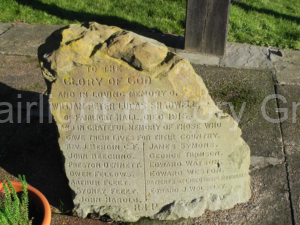
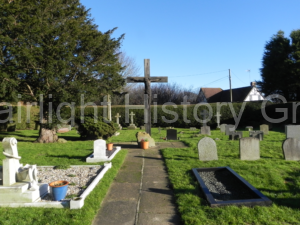
Additionally, at Fairlight, to the south of St. Andrew’s church and the Church of England graveyard, there is another smaller section of graveyard. This separate graveyard is dedicated to Roman Catholic burials and in the centre is a large wooden cross with a large inscribed stone at its base. To the casual observer this might mistakenly be taken to be the Fairlight memorial, but it is not.

The cross and stone were not always located here. In fact the Roman Catholic section of graveyard at Fairlight is a fairly recent development. The stone and cross were moved from the top of Chick Hill where they had been located in the grounds of Fairlight Cottage and the Roman Catholic Chapel. The Lucas-Shadwells had converted to Catholicism in 1902 and when they built Fairlight Cottage in 1906, the building contained its own private chapel. A few years later, a separate chapel was erected at the eastern end of the plot, on the edge of Chick Hill. (Fairlight Cottage has since been renamed The Down House, whereas the chapel has not been in service for many years and the property is now known as More Cottage).

Following WW1, Mrs Beatrice Lucas-Shadwell, who lost her husband William Peter to illness in 1915, decided that she should recognise the victims in Pett. Accordingly the cross and stone were erected in her grounds at Chick Hill. Interestingly the names remembered on the stone are mostly a separate list of names from the main Pett stone cross memorial, subsequently erected outside St. Mary and St. Peter’s church. The Lucas-Shadwell inspired stone was unveiled in May 1920 with great pomp and ceremony as reported in the Hastings and St. Leonards Observer. The main Pett stone cross memorial was dedicated later that same year, in December, and contains the comprehensive list of the victims of Pett.

The Lucas-Shadwell stone, now located at Fairlight is inscribed accordingly:-

“To the Glory of God and in loving memory of William Peter Lucas-Shadwell, of Fairlight Hall – died 1915-and in proud and grateful memory of those who gave their lives for their country, 1914-1919: Rev. John Burgiss C.F., John Beeching, Preston Dennett, Owen Fellows, John Harold, Reginald Jenner, Arthur Fleet, Sydney Fleet, James Symons, George Thomson, Edward Watson, Edward Weston, Patients of Cincu Hospital Roumania, Edward J Wolseley.”.

With the exception of Sydney Fleet, none of these people are named on either Pett or Fairlight memorials. Although we have started to research these names, any connection with Pett or Fairlight is unknown. However, we know that Captain William Noel Lucas-Shadwell was in service in many locations, including Roumania and Russia whilst his sister, Violet Belt, was a volunteer nurse in Roumania.

The principle Pett memorial, an engraved stone cross, is located outside St. Mary and St. Peter’s church and lists victims of both wars. Additionally Pett has wooden memorial boards inside the church, also for both wars, whereas there is another wooden plaque inside the Methodist church but for the WW1 victims only. The boundaries between the parishes of Fairlight and Pett have changed many times over the years and accordingly some of the victims were associated with both parishes and, in some cases the same man is remembered more than once on the different memorials eg. Henry Beeching, Albert Cox, Henry Barnes and George Glazier. In fact the Barden family, are generally remembered as being from Pett when in fact they were within the original Fairlight parish boundary at the time of both wars. As a result, I found it constructive to study the victims of both parishes when compiling the detail necessary for these articles.

The End.

If anyone has additional information relating to any of the above or knows of the family or friends of any of the victims can they please contact me (details at the front of the magazine). We know that some descendants still live in the area and we would like to hear from them. For further reading, can I suggest that readers refer to appendix 2 in Haydon Luke’s book ‘Fairlight, a Sussex Village by the Sea’.

By Paul Draper.


The Fairlight Victims of WW1 and WW2 and our War Memorials – Part 3

An article in four parts by Paul Draper published in Fairlight News in 2018


Part 3 – The WW2 victims associated with Fairlight and how they are remembered

In the previous magazines we introduced the subject of our victims from both wars and have looked at WW1 and all those men associated with Fairlight.

Inside St. Andrew’s church we have three plaques to our victims, one for WW1 victims, another for WW2 victims and a third, for one man, Hubert Samuel Alston Turner who died on 31st July 1917 in Flanders.

As we can see the WW2 plaque inside St. Andrew’s names four men. Additionally there is one WW2 CWGC gravestone, for Private Peter Gabbitas of the Royal Sussex Regiment.

The four men named are:-

1) Sergeant W. Op. Henry Lewis Barnes, 1382125 158 Sqdn., Royal Air Force Volunteer Reserve, who died 27th April 1943, aged 34, son of Henry and Louisa Rose Barnes of Fairlight Cove.

He is remembered at Rheinberg War Cemetery.

2) Sergeant Cyril Leslie Cruttenden, 977000, 90 Sqdn., Royal Air Force Volunteer Reserve, who died 21st April 1943.

He is remembered at Svino Churchyard.

3) Fusilier George Edward Glazier, 6410829, 11th Bn., Royal Scots Fusiliers, who died 28th August 1944, aged 19. He was the son of Samuel George and Sarah Mercy Glazier of Fairlight.

He is remembered at St. Desir War Cemetery.

4) Private Frank Message, 6412418, 1st Bn., East Surrey Regiment, who died 16th January 1943, aged 27. He was the husband of Dorothy Irene Message of Fairlight.

The above four men, from or associated with Fairlight, are all listed on the WW2 plaque inside St. Andrew’s, but another man is buried at Fairlight with a CWGC gravestone:-

5) Private Peter Gerald Gabbitas, 6408494, 70th Bn., Royal Sussex Regiment, who died 27th January 1941.

The CWGC state that he is remembered at Fairlight (St. Andrew’s) Churchyard.

(We are still investigating this, but records suggest that he died after falling from the cliffs near the Fairlight Glen minefield)

Additionally, a recent search of the online CWGC records has revealed a further seven men stated as being from Fairlight who lost their lives in WW2.

The seven further men are:-

6) Squadron Leader Arthur Marsden Lewis Alderton, 40066, 21 Sqdn., Royal Air Force, who died 21st January 1944, aged 24. He was the son of Ada D G W Alderton (nee Lewis) and husband of Kathleen Cameline Alderton of Fairlight.

He is remembered at Runnymede Memorial.

7) Lt. Col. John Dennis Francis Armstrong, 133116, Royal Army Medical Corps, who died 6th December 1944, aged 32. He was son of Richard Drake and Bertha Armstrong and husband of Suzanne Joan Armstrong of Fairlight, B.S., M.B., L.R.C.P., M.R.C.S.

He is remembered at Taukkyan War Cemetery.

8) Sapper Douglas Victor Barden, 2075180, 262 Field Coy., Royal Engineers, who died 25th April 1940, aged 19. He was the son of Thomas and Rosina Barden of Fairlight.

He is remembered at Dunkirk Memorial.

9) Private John Barden, 5350272, 10th Bn., Royal Berkshire Regiment, who died 19th January 1944, aged 25. He was the son of Charles and Hannah Barden of Fairlight.

He is remembered at Minturno War Cemetery.

10) Major Robert Peel, 79754, 11th Indian Div. Sigs., Royal Corps of Signal who died 28th February 1942, aged 28. He was the son of Mr and Mrs A L Peel of Fairlight.

11) 2nd. Lt. Edgar Frank Skyrme, EC/3759, 3rd Bn., 16th Punjab Regiment, who died 12th December 1941, aged 22. He was the son of Harold Edgar and Ethel Mary Skyrme.

He is remembered at Singapore Memorial.

12) Lt. Richard Henry Francis Truman, 148410, Royal Artillery, who died 16th June 1943, aged 32. He was the son of Herbert Charles and Edith Dorothy Truman of Fairlight and husband of Joan Margaret Truman.

He is remembered at Kanchanaburi War Cemetery.

George Edward Glazier, Douglas Victor Barden and John (Jack) Barden are also commemorated on the Pett War Memorials.

The WW2 plaque inside the church was apparently only erected in about 1992. Why only four men were named is not obvious. The additional eight men were also from or closely associated with Fairlight and I believe should be remembered here in Fairlight. We do have some photos and newspaper articles on some of the above men. Whilst we have such information for some, we do not for most and so, to be even, I am not including this. However, we have a photograph of the Pett Cricket Club taken at the time of the start of WW2. Sadly three of the men in this photograph lost their lives in the war and each of them was from Fairlight. They were Henry Lewis Barnes (back row, 3rd from right and Club Captain), John (Jack) Barden (with bat) and Douglas Barden (with ball). All three men were related. There are further members of the Barnes and Barden families in the photograph.

If anyone has additional information relating to any of the above or knows of the family or friends of any of the victims can they please contact me (details at the front of the magazine). We know that some descendants still live in the area and we would like to hear from them. For further reading, can I suggest that readers refer to appendix 2 in Haydon Luke’s book ‘Fairlight, a Sussex Village by the Sea’.

To be continued.


By Paul Draper.