


Apologies for the poor quality of some of the pictures.
Apologies for the poor quality of some of the pictures.


Haydon Luke and Paul Draper with Diane Mesure and family, a direct descendant of Noel Lucas-Shadwell


By Haydon Luke to be published in Fairlight News in June 2021
When this item appears in the Fairlight News, detailed memories of the Duke’s life and funeral will be fading – though the recollection of a moving ceremony on a perfect spring day in Windsor will undoubtedly endure in many minds. No nation can do ceremony, even in a scaled down version, half so well as Britain, and the image of the widowed Queen, solitary, in black, will have moved many hearts.
When news of the Duke’s death broke, several people were prompted to ask whether Fairlight had any associations with him. The FHG was asked to get to work to find the answer; one actual visit, two nearby and several people with direct personal recollections of encounters with him.
So far as we can be certain, though Hastings has enjoyed several Royal visits in the second Elizabethan era, Fairlight has only figured once – almost exactly 50 years ago. It was on 25th June, 1971, that the Duke paid a (literally) flying visit to the Coastguard Station at the end of Coastguard Lane. At the time the Fairlight Station was important and in the course of modernisation. It had nine volunteer watchmen and 15 in the rescue section and was then the principal station in the area.

.Piloting the helicopter himself, the Duke landed in the field adjacent to the Coastguard Cottages at 3.00 p.m. in front of a crowd of several hundred people. He inspected the lookout and communications room and met Station Officer B Beard and Coastguards F Davis and R Gibbons. He heard about the cliff rescue service operated from Fairlight then went into the married quarters and met the wives of coastguards, including Mrs Beard and Mrs Gibbons. The local paper reported that “he asked the wives about their accommodation. He looked round Mr Beard’s house and asked the children where they went to school and Mrs Beard about how she got them to school and how she did her shopping.”
After his inspection Prince Philip set off for Newhaven to visit another clifftop Coastguard unit there.
Later the same year, in July, the Duke came close to Fairlight when fulfilling another Coastguard-related duty when he visited Lade, near Lydd, where he formally opened Coastguard houses. This visit was in his capacity as Master of the Corporation of Trinity House. As in the Fairlight visit the Duke’s mode of transport was helicopter, which was apparently re-scheduled to make an additional landing for him to perform this duty at Lade.
The most significant Royal Visit locally included both the Queen and the Duke of Edinburgh. It took place in the autumn of 1966 and was part of an ambitious East Sussex tour which started at Battle, went on to Rye and Winchelsea, continued to Hastings and ended at Eastbourne.
Pett resident Tim Rothwell remembers the royal visit by the Queen and the Duke to Rye on that wet October day in 1966. He was a school prefect at Rye Grammar School and had to supervise a class at the end of Rope Walk. He and his charges had a brief view of the Royal motorcade as it drove along Cinque Ports Street from the Udimore Road before turning right through the Landgate to access Market Street and the Town Hall. Tim  said:” I still remember shivering at the end of Rope Walk by what was the Runcible Spoon (it was an off licence in those days) making sure that the pupils in the form I was looking after didn’t run into the road!”
Rye’s Own magazine reported the visit very much in the style of the time.
“As Her Majesty alighted from the Royal Car the cheering crowd could see she was dressed in a pink tweed coat flecked with white, over a pink dress. She wore a close fitting hat in matching pink, with black accessories. Prince Philip waved his hat to the crowd as the Royal Party walked into the Town Hall.”
Visitors’ book signed, the Queen and Prince Philip made a quick visit to the Church and performed a short walkabout on their way to the Rye War Memorial. Rye’s Own takes up the story again.
“At the War Memorial, Mr. John Button, a fisherman who has lived in Rye all his life, waited to greet Her Majesty with a gift of Rye Bloaters. Prince Philip asked Mr. Button what should be eaten with Bloaters? John replied that the best way of eating them was with bread and butter, anything else might spoil the flavour….as the Royal couple stood talking with Mr. Button and with the Mayor and Mayoress, Prince Philip suddenly took a nautical interest in his surroundings and pointed out Rye Harbour. No doubt he remembered it from his sea going days.
As the Church clock struck twelve, the time had come for departure via a flag-bedecked (and bumpy) Mermaid Street and on to Winchelsea and Hastings. Rye’s brief moment in the royal sight was over. For the Royal party that day Rye was only a small part of their East Sussex itinerary.
It was the Hastings part of that tour, on Friday, 28th October, 1966, which had a strong Fairlight dimension. That was the occasion when the Queen and the Duke came to visit the famous 1966 Hastings Embroidery when it was displayed in the Triodome on Hastings Pier.

In the photograph from that occasion we can see Group Captain Ralph Bagshaw Ward of Stonelynk Farm, Fairlight, discussing the panels with Her Majesty. Characteristically doing his own thing, the Duke appears perhaps even more interested in the details of the construction of the Triodome than of the embroidery itself. The Group Captain was a prominent Fairlight resident and the mastermind behind the highly successful Hastings  Embroidery project.
Our final recollection of the Duke is supplied by local resident Nick Jury. His encounter took place in Newhaven where he met the Duke when he was commencing his Duke of Edinburgh Award Scheme hike as an ATC member. Nick told us “I was in my last year at school, 1970. The actual location of my meeting was Piddinghoe just outside Newhaven.” Here is the photograph he has to prove it! Nick is opposite the Duke, leaning in.
It is fitting to end with Nick’s reference to the Duke of Edinburgh’s Award Scheme which many local youngsters have benefited from over the years and which may well prove to be one of the most enduring parts of Prince Philip’s legacy to the country and people he served so faithfully.
By Haydon Luke
Fairlight does not have a complete War Memorial where we can meet and hold ceremonies to commemorate our victims of World War 1 and World War 2. The present situation is incomplete, inaccurate and bitty. Yes, we have three plaques inside St. Andrew’s Church, two Commonwealth War Graves Commission stones in the graveyard and a large stone in the Catholic Burial Ground, but even together they do not record the full list of our victims. We think that the time has come for Fairlight to put the record straight.
Readers of Fairlight News will remember that in 2018 I prepared a full story covering our existing memorials, written in four parts. (See Fairlight History Group’s website at www.fairlighthistory.co.uk if you no longer have your magazine.) Because of the connections between our two Parishes, I wrote about both Fairlight and Pett together and whilst researching the stories I discovered that both Parishes had many missing names. In the case of Pett, it was possible to prepare an additional plaque to the missing ten men to supplement the existing memorial and this was unveiled at a special ceremony on 11th November 2018. The situation was different for Fairlight and we were unable to organise matters in time.
In late 2019 we started investigating the possibility of rectifying the Fairlight situation and a small steering group was set up to oversee the process. It comprised representatives from Fairlight Parish Council, Fairlight Parochial Church Council, the Royal British Legion and Fairlight History Group, all endorsed by Fairlight Parish Council. We made rapid progress but then sadly the Covid 19 situation developed and the project had to take a back seat.
At the same time we had decided it would be fitting if a small additional plaque were to be placed in our Village Hall to commemorate all those people who had made contributions to the WW2 war effort. This was completed and installed by VE Day, 8th May 2020, the 75th anniversary of the ending of hostilities in Europe. Sadly, all the planned formalities surrounding the unveiling had to be cancelled, but when you finally get back into the Village Hall you can see it there in the Small Hall.

The New VE Day Plaque installed in the Small Village Hall
The existing plaques remember nineteen men who lost their lives in WW1 and four from WW2. Additionally there is a family plaque for 2nd Lt Samuel Hubert Alston Turner, a member of the influential local family, the Martineaus, after whom Martineau Lane is named. Our investigations have shown that another ten names could have been included for WW1 and another thirteen, including three civilians for WW2. The steering group has checked the cases for all of these people and agreed that the new complete memorial should include their names.


The existing WW1 plaque remembering nineteen men and the family plaque of 2nd Lt. Hubert Samuel Alston Turner of the Martineau family.

The steering group has considered the options for where in the Parish of Fairlight the new memorial should be located and has concluded that the best situation will be to place it near St. Andrew’s, on the land immediately outside the graveyard. This will give clear accessibility on special occasions and make it available to all, throughout the year. The picture below gives a sense of what is intended. The impression is necessarily approximate because it all depends on the exact stone we are able to acquire.

An impression of the proposed new memorial in situ.
We were unable to complete this project last year because of the pandemic but this year we aim to have matters complete in time for Remembrance Day in November. There is still a lot to do but the Parish Council has endorsed the proposals of the steering group which has prepared a plan of action to achieve the project. We need to have final permission from the church authorities and also from Rother District Council. Hopefully, by the time you read this, we will have found an architect or draughtsman, drawn up professional plans and submitted them to the previously mentioned authorities.
Clearly, the project will need financing and unfortunately there is no national fund to pick up the cost which is expected to be around £7000. Fairlight Parish Council has so far supported the project by covering the cost of the planning applications and previously they paid for the plaque commemorating the 75th anniversary of VE Day. But for the balance we will be launching a public fund-raising campaign in addition to seeking grants and donations from interested parties, associated organisations and, finally, from the people of Fairlight.
In the summer, on the weekend of 10th/11th July, in conjunction with the 2021 Fairlight Open Gardens event, there will be a comprehensive fund-raising exhibition in the Village Hall of Fairlight in the two World Wars, including details of all the people to be commemorated on the new memorial. In that connection, if you know of a family member, colleague or friend who you believe should be included, please urgently contact us with the details.
Finally, we hope you will all agree that it is our duty to honour and respect all of those men and women of Fairlight, service personnel and civilians, who gave their lives in those conflicts and that, however belatedly, it is now within our power to set the record straight in perpetuity.
By Paul Draper (2021)
Part 4 – The Roman Catholic cross and stone at Fairlight and their connection to Pett
In the previous magazines we discussed the victims from both wars and looked at how and where all those men associated with Fairlight are remembered.
Additionally, at Fairlight, to the south of St. Andrew’s church and the Church of England graveyard, there is another smaller section of graveyard. This separate graveyard is dedicated to Roman Catholic burials and in the centre is a large wooden cross with a large inscribed stone at its base. To the casual observer this might mistakenly be taken to be the Fairlight memorial, but it is not.
The cross and stone were not always located here. In fact the Roman Catholic section of graveyard at Fairlight is a fairly recent development. The stone and cross were moved from the top of Chick Hill where they had been located in the grounds of Fairlight Cottage and the Roman Catholic Chapel. The Lucas-Shadwells had converted to Catholicism in 1902 and when they built Fairlight Cottage in 1906, the building contained its own private chapel. A few years later, a separate chapel was erected at the eastern end of the plot, on the edge of Chick Hill. (Fairlight Cottage has since been renamed The Down House, whereas the chapel has not been in service for many years and the property is now known as More Cottage).
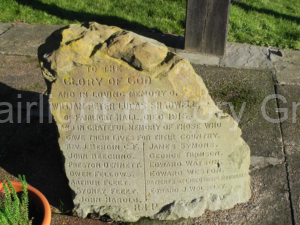
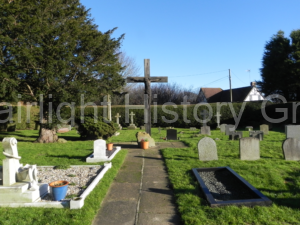
Following WW1, Mrs Beatrice Lucas-Shadwell, who lost her husband William Peter to illness in 1915, decided that she should recognise the victims in Pett. Accordingly the cross and stone were erected in her grounds at Chick Hill. Interestingly the names remembered on the stone are mostly a separate list of names from the main Pett stone cross memorial, subsequently erected outside St. Mary and St. Peter’s church. The Lucas-Shadwell inspired stone was unveiled in May 1920 with great pomp and ceremony as reported in the Hastings and St. Leonards Observer. The main Pett stone cross memorial was dedicated later that same year, in December, and contains the comprehensive list of the victims of Pett.
The Lucas-Shadwell stone, now located at Fairlight is inscribed accordingly:-
“To the Glory of God and in loving memory of William Peter Lucas-Shadwell, of Fairlight Hall – died 1915-and in proud and grateful memory of those who gave their lives for their country, 1914-1919: Rev. John Burgiss C.F., John Beeching, Preston Dennett, Owen Fellows, John Harold, Reginald Jenner, Arthur Fleet, Sydney Fleet, James Symons, George Thomson, Edward Watson, Edward Weston, Patients of Cincu Hospital Roumania, Edward J Wolseley.”.
With the exception of Sydney Fleet, none of these people are named on either Pett or Fairlight memorials. Although we have started to research these names, any connection with Pett or Fairlight is unknown. However, we know that Captain William Noel Lucas-Shadwell was in service in many locations, including Roumania and Russia whilst his sister, Violet Belt, was a volunteer nurse in Roumania.
The principle Pett memorial, an engraved stone cross, is located outside St. Mary and St. Peter’s church and lists victims of both wars. Additionally Pett has wooden memorial boards inside the church, also for both wars, whereas there is another wooden plaque inside the Methodist church but for the WW1 victims only. The boundaries between the parishes of Fairlight and Pett have changed many times over the years and accordingly some of the victims were associated with both parishes and, in some cases the same man is remembered more than once on the different memorials eg. Henry Beeching, Albert Cox, Henry Barnes and George Glazier. In fact the Barden family, are generally remembered as being from Pett when in fact they were within the original Fairlight parish boundary at the time of both wars. As a result, I found it constructive to study the victims of both parishes when compiling the detail necessary for these articles.
The End.
If anyone has additional information relating to any of the above or knows of the family or friends of any of the victims can they please contact me (details at the front of the magazine). We know that some descendants still live in the area and we would like to hear from them. For further reading, can I suggest that readers refer to appendix 2 in Haydon Luke’s book ‘Fairlight, a Sussex Village by the Sea’.
By Paul Draper.
Part 3 – The WW2 victims associated with Fairlight and how they are remembered
In the previous magazines we introduced the subject of our victims from both wars and have looked at WW1 and all those men associated with Fairlight.
Inside St. Andrew’s church we have three plaques to our victims, one for WW1 victims, another for WW2 victims and a third, for one man, Hubert Samuel Alston Turner who died on 31st July 1917 in Flanders.

As we can see the WW2 plaque inside St. Andrew’s names four men. Additionally there is one WW2 CWGC gravestone, for Private Peter Gabbitas of the Royal Sussex Regiment.
The four men named are:-
1) Sergeant W. Op. Henry Lewis Barnes, 1382125 158 Sqdn., Royal Air Force Volunteer Reserve, who died 27th April 1943, aged 34, son of Henry and Louisa Rose Barnes of Fairlight Cove.
He is remembered at Rheinberg War Cemetery.
2) Sergeant Cyril Leslie Cruttenden, 977000, 90 Sqdn., Royal Air Force Volunteer Reserve, who died 21st April 1943.
He is remembered at Svino Churchyard.
3) Fusilier George Edward Glazier, 6410829, 11th Bn., Royal Scots Fusiliers, who died 28th August 1944, aged 19. He was the son of Samuel George and Sarah Mercy Glazier of Fairlight.
He is remembered at St. Desir War Cemetery.
4) Private Frank Message, 6412418, 1st Bn., East Surrey Regiment, who died 16th January 1943, aged 27. He was the husband of Dorothy Irene Message of Fairlight.
The above four men, from or associated with Fairlight, are all listed on the WW2 plaque inside St. Andrew’s, but another man is buried at Fairlight with a CWGC gravestone:-
5) Private Peter Gerald Gabbitas, 6408494, 70th Bn., Royal Sussex Regiment, who died 27th January 1941.
The CWGC state that he is remembered at Fairlight (St. Andrew’s) Churchyard.
(We are still investigating this, but records suggest that he died after falling from the cliffs near the Fairlight Glen minefield)
Additionally, a recent search of the online CWGC records has revealed a further seven men stated as being from Fairlight who lost their lives in WW2.
The seven further men are:-
6) Squadron Leader Arthur Marsden Lewis Alderton, 40066, 21 Sqdn., Royal Air Force, who died 21st January 1944, aged 24. He was the son of Ada D G W Alderton (nee Lewis) and husband of Kathleen Cameline Alderton of Fairlight.
He is remembered at Runnymede Memorial.
7) Lt. Col. John Dennis Francis Armstrong, 133116, Royal Army Medical Corps, who died 6th December 1944, aged 32. He was son of Richard Drake and Bertha Armstrong and husband of Suzanne Joan Armstrong of Fairlight, B.S., M.B., L.R.C.P., M.R.C.S.
He is remembered at Taukkyan War Cemetery.
8) Sapper Douglas Victor Barden, 2075180, 262 Field Coy., Royal Engineers, who died 25th April 1940, aged 19. He was the son of Thomas and Rosina Barden of Fairlight.
He is remembered at Dunkirk Memorial.
9) Private John Barden, 5350272, 10th Bn., Royal Berkshire Regiment, who died 19th January 1944, aged 25. He was the son of Charles and Hannah Barden of Fairlight.
He is remembered at Minturno War Cemetery.
10) Major Robert Peel, 79754, 11th Indian Div. Sigs., Royal Corps of Signal who died 28th February 1942, aged 28. He was the son of Mr and Mrs A L Peel of Fairlight.
11) 2nd. Lt. Edgar Frank Skyrme, EC/3759, 3rd Bn., 16th Punjab Regiment, who died 12th December 1941, aged 22. He was the son of Harold Edgar and Ethel Mary Skyrme.
He is remembered at Singapore Memorial.
12) Lt. Richard Henry Francis Truman, 148410, Royal Artillery, who died 16th June 1943, aged 32. He was the son of Herbert Charles and Edith Dorothy Truman of Fairlight and husband of Joan Margaret Truman.
He is remembered at Kanchanaburi War Cemetery.
George Edward Glazier, Douglas Victor Barden and John (Jack) Barden are also commemorated on the Pett War Memorials.
The WW2 plaque inside the church was apparently only erected in about 1992. Why only four men were named is not obvious. The additional eight men were also from or closely associated with Fairlight and I believe should be remembered here in Fairlight. We do have some photos and newspaper articles on some of the above men. Whilst we have such information for some, we do not for most and so, to be even, I am not including this. However, we have a photograph of the Pett Cricket Club taken at the time of the start of WW2. Sadly three of the men in this photograph lost their lives in the war and each of them was from Fairlight. They were Henry Lewis Barnes (back row, 3rd from right and Club Captain), John (Jack) Barden (with bat) and Douglas Barden (with ball). All three men were related. There are further members of the Barnes and Barden families in the photograph.

If anyone has additional information relating to any of the above or knows of the family or friends of any of the victims can they please contact me (details at the front of the magazine). We know that some descendants still live in the area and we would like to hear from them. For further reading, can I suggest that readers refer to appendix 2 in Haydon Luke’s book ‘Fairlight, a Sussex Village by the Sea’.
To be continued.
By Paul Draper.
Part 2 – The WW1 victims associated with Fairlight and how they are remembered
In the previous magazine we introduced the subject of our victims from both wars. This time we will look at WW1 and all those men associated with Fairlight.
Inside St. Andrew’s church we have three plaques to our victims, one for WW1 victims, another for WW2 victims and a third, for one man, Hubert Samuel Alston Turner who died on 31st July 1917 in Flanders.


As we can see the main plaque names nineteen men, including 2nd Lt. Turner, who has the above separate plaque from his family.
The nineteen men are:-
1) Private Charles Gilbert, 2204 West Kent Yeomanry (Queen’s Own), who died 31st August 1916. He is remembered at Thiepval.
2) Ordinary Seaman Frank C Cook A B, J/17465 H.M.S. Bulwark, Royal Navy, who died 26th November 1914 aged 18, son of Albert and Elizabeth Cook. He is remembered at Portsmouth Naval Cemetery.
3) Private Henry Charles Beeching, 1716, 2 Bn. Royal Sussex Regiment, who died 26th August 1915, aged 26, son of Luke and Ellen Beeching of Pett Road, Fairlight.
He is remembered at Vermelles British Cemetery.
4) Private L Osborne, 11388, 1st Bn. Coldstream Guards, who died 7th July 1916 aged 20, son of Anthony and Fanny Osborne of Black Brooks, Guestling.
He is remembered at Essex Farm Cemetery.
5) Boy 2nd class Jesse George Dadswell, J/53152, H.M.S. Ganges, Royal Navy, who died on 16th August 1916, aged 15. Jesse died of pneumonia in Shotley, Suffolk, England and is remembered with a CWGC stone at Fairlight, near the entrance to St. Andrew’s.
6) Private Peter James Harrod, 7743, 9th Bn. Royal Sussex Regiment, who died 15th August 1916, aged 22, son of Benjamin and Martha Harrod of Middle Road, Ore.
He is remembered at Delville Wood Cemetery, Longueval.
7) Major Alfred John Martineau, 19th Siege Bty, Royal Garrison Artillery, who died 17th April 1917, aged 46. He was the son of Alfred and Maria Martineau and husband of E. Louisa Martineau of 6 Evelyn Terrace, Brighton. (a descendant of the Martineau family of Fairlight Lodge).
He is remembered at Bully-Grenay Communal Cemetery, British Extension.
8) Able Seaman Leonard John Burton, Sussex Z/413, Hood Bn. R.N.Div., Royal Naval Volunteer Reserve, who died on 22nd April 1917.
He is remembered at Dulsans British Cemetery, Etrun.
9) Private Reginald James Marchant, TF/201997, 4th Bn. Royal Sussex Regiment, who died 4th May 1917, aged 19, son of Albert and Emily Marchant of Church Farm, Fairlight.
He is remembered at Savona Memorial. (His brother, Albert, also died in action – see below).
10) Private Albert Henry Marchant, 240660, 1st/5th Bn. Royal Sussex Regiment, who died 30th April 1918, aged 24, son of Albert and Emily Marchant of Church Farm, Fairlight.
He is remembered at Granezza British Cemetery. (His brother, Reginald, also died in action – see above).
11) Serjeant George R Suters, 201407, 2nd/1st Bn. London Regiment (Royal Fusiliers), who died 16th June 1917.
He is remembered at Arras Memorial.
12) 2nd Lt. Hubert Samuel Alston Turner, 2nd Bn. Yorkshire Regiment, who died 1st August 1917, aged 20, the only son of Herbert and Geraldine Turner (a descendant of the Martineau family of Fairlight Lodge). He has a separate plaque at St. Andrew’s.
He is remembered at Ypres (Menin Gate) Memorial.
13) Private Charles Kemp, G/17960, 13th Bn. Royal Sussex Regiment, who died 31st July 1917, aged 34, son of Charles and Kezia Kemp.
He is remembered at Buffs Road Cemetery. (Fairlight residents visited his grave in 2014).
14) 2nd Lt. Pruett Mullens Dennett, 208th Sqdn, Royal Air Force, who died 2nd June 1918, aged 19. He was son of Mrs E L Sandy (formerly Dennett) of 71 Preston Road, Brighton and the late R M Dennett.
He is remembered at Arras Flying Services Memorial.
15) Private William Victor Long, 245369, West Kent Yeomanry (Queen’s Own), who died 31st August 1916.
He is remembered at Thiepval Memorial.
16) Driver Albert Cox, 141035, 68th Field Coy. Royal Engineers, who died 15th January 1918, aged 32, grandson of Jesse Cox of Cecil Cottage, Pett Level Road. (His name is engraved on the gravestone of Jesse Cox, near the entrance to St. Andrew’s).
He is remembered at Boulogne Eastern Cemetery.
17) Lt. Charles William Jemmett, 5th Bn. The Buffs (East Kent Regiment) who died 15th March 1918, aged 32. He was son of William Francis Bond and Edith Jemmett of Ashford, Kent and husband of Dorothy Elizabeth Cotterell (formerly Jemmett) of Sussex House, Winchester.
He is remembered at Brissay-Choigny Churchyard.
18) Private F R Burton, 4013, 3rd Bn. Australian Infantry, A.I.F., who died 18th September 1918.
He is remembered at Villers-Bretonneux Memorial.
19) Captain Alexander Gordon Wynch Murray M.B.E., T.F. Adjt. Staff School (Cambridge), Officers’ Training Corps, who died 15th February 1919, aged 34. He was son of Alexander Elder and Mary Charlotte Irene Murray.
He is remembered at Walmer (St. Mary) Old Churchyard, Kent.
Albert Cox and Henry Charles Beeching are also commemorated on the Pett War Memorials.
The above nineteen men, from or associated with Fairlight, are all listed on the WW1 plaque inside St. Andrew’s, but two more men are buried at Fairlight with their families and the CWGC attend their graves:-
20) Captain Robert Cecil Burton, 2nd Bn. Rifle Brigade, aged 32 who died 16th March 1915, son of Mrs E A Burton of 18 Mansion Place, Queen’s Gate, London. The family grave inscription states “Died at Boulogne of wounds received at the Battle of Neuve Chapelle, France”. The burial register gives address as St. Leonard’s Lodge, St. Leonards-on-Sea.
The CWGC state that he is remembered at Fairlight (St. Andrew’s) Churchyard.
21) Lt. Stuart Underwood Baily, 490th (Home Counties) Field Coy. Royal Engineers, who died 15th September 1918, aged 32. He was son of Cornwallis and Marion Baily of 6 Dane Road, St. Leonards-on-Sea. The CWGC state that he is remembered at Fairlight (St. Andrew’s) Churchyard.
Two other brothers, William Guy Lloyd-Worth and Frederick John Lloyd-Worth, are also associated with Fairlight. The records show that their family were from French Court Farm which, at that time, was located in the enlarged Fairlight Parish. Frederick is remembered at Lone Pine Memorial, but William, who died only in February 1921, is remembered at Netley Military Cemetery.
Finally, there are more names mentioned on the independent memorial stone in the Catholic section at Fairlight. I will look at these in the final part of this series.
We do have some photos and newspaper articles on some of the above men. Whilst we have such information for some, we do not for most and so, to be even, I am not including this, except for the youngest victim. Jesse Dadswell stands out as being only 15 years old and in fact, never left these shores, dying from pneumonia at the land-based H.M.S. Ganges training establishment in Suffolk. His family worked at Fishponds Farm, Barley Lane and lived at Tile Kiln Cottages, both then part of Fairlight Parish, and his nephew, Chris, and other family are still based locally. They have supplied some information for us to share.


If anyone has additional information relating to any of the above or knows of the family or friends of any of the victims can they please contact me (details at the front of the magazine). We know that some descendants still live in the area and we would like to hear from them. For further reading, can I suggest that readers refer to appendix 2 in Haydon Luke’s book ‘Fairlight, a Sussex Village by the Sea’.
To be continued.
By Paul Draper.
Part 1 – How and where do we remember our fallen in Fairlight?
On the 11th November this year the country will remember the one hundredth anniversary of the ending of WW1 hostilities. All across our country, each community will celebrate the event in their own separate ways. It would appear that following the end of both WW1 and WW2 each community sought to remember those local men who had given their lives for their country. However the style and size of each memorial and the list of those men remembered was left to the communities to organise. As a result it seems that the memorials are a little inconsistent when studied carefully.
So what do we have in Fairlight and where are the memorials? The answer is inside St. Andrew’s church where we find three marble plaques mounted on the wall, next to the organ, remembering victims of WW1 and WW2. The WW1 plaque lists nineteen men and the WW2 plaque lists just four men. (see below). The third plaque is to one man, 2nd Lt. Hubert Samuel Alston Turner, erected by his family.

(It is somewhat confusing but next to St. Andrew’s church and graveyard, on the southern boundary is a small piece of land dedicated to and operated by the Catholic church. This is totally separate from the Church of England’s St. Andrew’s church and its graveyard. In the Catholic cemetery is a large wooden cross with an engraved stone at its base. Although at first glimpse this appears to be the Fairlight memorial, it is not and in fact was only moved there from Chick Hill, Pett when their small Catholic church was closed and the associated land deconsecrated. I will expand on this later.)
In addition to the two plaques inside St. Andrew’s we have a further four graves in the churchyard that are attended to by the CWGC (The Commonwealth War Graves Commission). Two of these are commemorated with the standard CWGC white stones, one from WW1, Jesse G Dadswell AB, and one from WW2, Pte Peter Gerald Gabbitas. The other two CWGC victims, Lt. Stuart Underwood Baily and Capt. Robert Cecil Burton, are simply remembered on their existing family gravestones. Of these four, only Jesse Dadswell is also remembered on the marble plaques. I cannot see a direct reason for these apparent inconsistencies.
However, further research has revealed that Fairlight had more victims than the total of twenty three names that appear on the two plaques plus the three additional men mentioned above who are remembered by the CWGC. Why were these other names not included? It will be impossible to find out all the facts so I will simply list the details of the additional victims as today we cannot put ourselves in the shoes of those who helped create the memorials. I will not go into the full detail of our victims, including the additional names, in this opening article but will expand on this subject in the following articles.
In March 2018 the CWGC added a discreet plaque to the front gates of St. Andrew’s advising visitors that the graveyard contains CWGC graves. In fact the CWGC have just implemented this policy across the entire country as a guide to all visitors.
In the next article, we will list the full names and details of all the Fairlight WW1 victims, including those who have so far not been included. Similarly, after that we will study the victims and memorials of our WW2 victims. Finally, we will look at the Catholic memorials and the overall situation with our neighbouring Parish of Pett as there is some overlap between our Parishes and, as a result, some men are named in both Fairlight and Pett.
If anyone has additional information relating to any of the above or knows of the family or friends of any of the victims can they please contact me (details at the front of the magazine). For further reading, can I suggest that readers refer to appendix 2 in Haydon Luke’s book ‘Fairlight, a Sussex Village by the Sea’.
To be continued.
Paul Draper.
We chatted to Vic in October 2020 and he was happy to share snippets of his memories from Fairlight and Pett. We list some of those memories below, in no particular order:
Vic was born just before the war in New Barn Farm, off Rosemary Lane (now known as Low Winters Farm).
When he was five the family moved to Waites Barn Cottage, Waites Lane where he remained until 1962 when he married. Waites Barn Cottage was located next to where Hairbase the hairdresser stands today, but was demolished many years ago and replaced with a new house. He lived there with his parents, his sister, his younger brother (Keith’s dad) and his older brother, Bert.

New Barn Farm had been split into 2 households and was owned by a Charlie Colegate (he was related to the Fields family) and Vic’s family rented one half. They had to leave when Mr.Colegate wanted the farm back.
Vic’s grandparents lived in Lunsford Cottages, Pett and his grandfather worked on Lunsford Farm as a carter.
In 1952, Vic’s first job was with Mark Moon, the milkman. Mark Moon bottled his milk at Whiteman’s farm in Peter James Lane (Winterstow). In later years it was delivered to Pett Road by a firm called T.Bates from Hastings. Vic delivered to addresses all over Fairlight. Keith Glazier’s mum also worked for Mark. Vic recalls that Mark was cricket mad.
Vic remembers that everything was delivered to the door. Some such deliveries in the village included:-
Mr.Wells the local fishmonger. He lived in Battery Hill and had a brick-built cold store in the land opposite his front door. Harry was a baker who worked for the Co-op. There was another bakery called ‘Henry, King of Feist’ in Ore.
In the 1940s there was a five bar gate across Waites Lane manned by Jack Haynes. He wouldn’t let people through to the Firehills Estate unless they could prove they had business there. It was a private estate at that time owned by Godfrey Weston Hickman.
Mr. and Mrs. Rimmington ran the Woolpack Shop and when they were bombed out during the War, they moved across the road.
A bus was owned and operated from the Royal Oak, Pett. Bubbles Turner drove the old bus and the route included driving through Stream Lane. [Pictures exist of the bus parked outside the Royal Oak]
Later the local bus routes were operated by the East Kent Road Car Company (East Kent). They had a conductor to take the money and their buses were painted red and cream. The East Kent bus to Fairlight was the 128.
In 1951/2 Vic was on a full bus attempting to go up Battery Hill. Just before Peter James Lane everyone had to get off the bus and push as it couldn’t get up the hill. Apparently this was a frequent occurence
Vic’s father in law, Mr.Osborne, helped to build the steps down to the beach in Fairlight – they accessed the beach from the sea.
Vic remembers that a Jack Morton managed a pumping station that pumped water to Gorsecliffe. There was a big water tank at the top of Fyrsway. There was a large brick-built, open-topped water tank on the left by the Circle. Vic remembers sailing boats on the tank as a child.
A wheel from a crashed RAF plane was found on the beach at Pett Level. The RAF came and took it away to a museum.
In 1951 the Fairlight Youth Club joined with other youth clubs to re-enact the Battle of Hastings at Arundel Castle in front of the then Princess Elizabeth (later Queen Elizabeth II). Vic gave all the paperwork to Hastings History House.
There were many small local builders, such as Stan Dyer, Reg Sweetman, Barden & Sons Ltd, J.J. Hills, T.E. Relfe, Colegate & Sons, etc. Reg Sweetman’s company was based where Just Property is now and their shed was where Hair Base is now. Reg built many houses in Fairlight Cove and Council houses in Elm Lane, Pett after the war.
Vic’s grandfather, Harry, was listed in 1911 as a ‘well sinker’.
A Lady Tyrwhitt Drake lived in Channel Way and owned a zoo in Maidstone. She drove a Rolls Royce. [nb There is now a Tyrwhitt-Drake collection of carriages on display at Maidstone Museum].
There was a café opposite the Circle shop and a working men’s café on the corner of Farley Way opposite Pixie Wood. [Pixie Wood was a family run tea-room for many years]
Vic’s sister lived at Coastguard Cottages on the Firehills for 50 years.
The car park opposite The Smugglers at Pett Level was a lovely green and the first Pett Flower Show was held there.
A Miss Barry lived at Waites Farm and during the war, she worked as a medic.
Mr.and Mrs.Sandford ran the shop in Lower Waites Lane before the two ladies ran the butter shop.
The Pett Level Chronicles were started by Mr.Seaton who owned Pett Level. He lived opposite Tonge House at Cliff End and possibly built the Smugglers pub.
The Gosticks ran the Smuggler and owned considerable land at Pett Level.
Pett Garage was run by Jimmy Goodsell. [nb. The garage was located where Tic Toc is today]
By Karen and Paul Draper, October 2020